
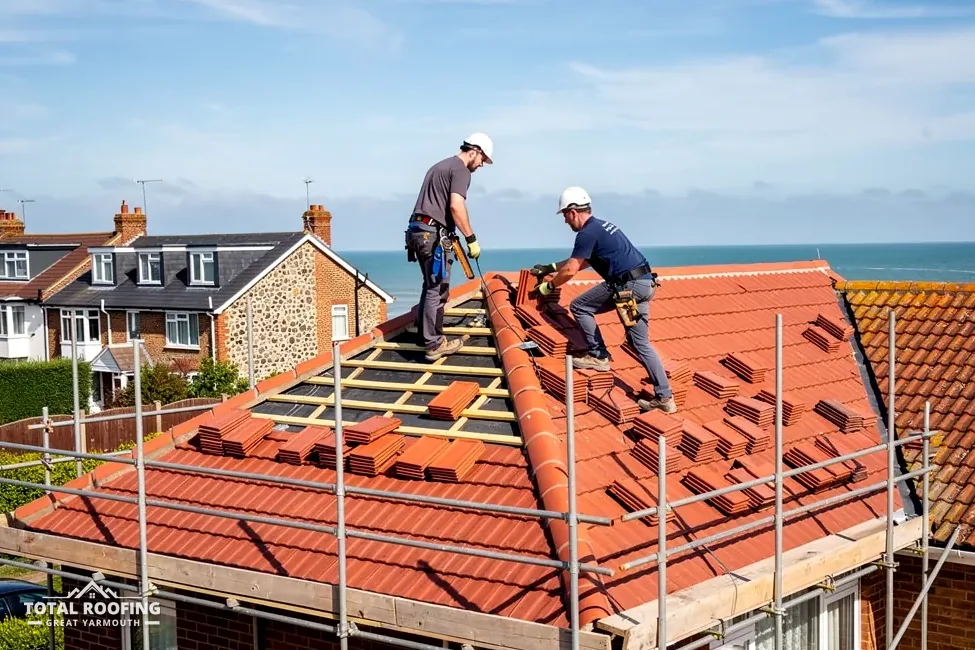
Where two slopes meet and drain into one line
A roof valley is the internal angle formed where two sloping roof planes meet and fall towards each other. Rain landing on both slopes runs down into that angle, so the valley takes the drainage of two slopes into one narrow channel. The rest of the roof sheds water over a wide area of tiles; the valley gathers it up and delivers it to the gutter at the eaves, or onto a lower roof.
That job explains why a valley is checked as its own part of the roof. The lining along the line, the tiles or slates cut to meet it, the boards or battens beneath and the point where it discharges all have to work together. A hole the size of a coin in a plain slope lets in a trickle. The same hole in a valley sits where the water arrives in volume.
Valleys appear wherever a roof has an L-shape, a T-shape, a dormer, a bay with its own pitched roof or an extension that meets the main roof at an angle. A valley fault can also hide itself: water may travel along a rafter or under a lining before a stain reaches a ceiling, so the stain and the hole can sit well apart. Our guide on how to find a roof leak explains how the tracing works.
Roof valley repair covers four broad situations: clearing a valley that has silted up, patching or re-lining a valley that has split or worn, re-bedding cut tiles along its edges, and rebuilding a valley whose construction no longer suits the roof. The sections below take the valley types first, then the faults, then the decision between mending and replacing.
Lead, GRP, tiled and mortar valleys compared
Four constructions turn up on pitched roofs, and the repair depends on which one is in front of you. The table sets them side by side. Which one a house has is found on the survey: it cannot be told reliably from the ground, because the lining is the part that is hidden.
| Valley | How it is built | What the repair looks at |
|---|---|---|
| Lead | Lead sheet laid in the angle over a boarded base, with a strip left uncovered at the middle | Splits, worn patches, lead too narrow or too thin for the roof |
| GRP | A moulded glass-reinforced plastic trough set into the angle, with tiles dressed over its edges | Cracks, lifted laps, tiles resting hard on the trough |
| Tiled | Special valley tiles, or tiles cut and laid to meet along the line, over a lining | Slipped or cracked cut tiles, a lining that has perished beneath |
| Mortar-bedded | Cut tiles bedded in mortar along the line of the valley | Cracked or missing mortar, tiles that have shifted, water getting under the bed |
The first three are lined: something waterproof sits underneath the tiles and does the real work of carrying the water. In a mortar-bedded valley the cut tiles and the mortar do more of that work themselves, so the bed is the part to watch. Marley's own wording on the wider point is that since the 2015 amendments to BS 5534, mortar could no longer be relied upon as the only means of securing the roof covering, which is one reason a mortar-bedded valley is looked at closely before it is simply patched with more mortar.
None of this makes one construction right and another wrong. A lead valley that is sized and laid well is a sound detail, and a GRP trough is a sensible choice on a long run. The faults come from what has happened to the detail since it was built, which the next sections cover.
What the survey checks along a valley
- Which of the four constructions the valley is
- Debris, moss or silt lying in the channel
- Splits, holes or worn patches in the lining
- Cut tiles that have slipped, cracked or lifted
- The width of the lining beside the tiles
- Where the valley ends at the gutter or lower roof
Debris in the channel and the water that backs up
A valley only works while water can run freely along it. Leaves, moss, silt from old tiles, the remains of a bird's nest and fallen pieces of mortar can all settle in the channel and slow the flow. Where the water slows, it rises, and a valley that fills to the edge of the lining can push water sideways under the cut tiles instead of letting it run down.
This is a different fault from a split lining, and it needs a different fix. A valley that is only blocked is cleared by hand and the flow is checked; there is nothing to re-line. The trouble is that a blockage can also hide a split, because the debris keeps the lining damp and sits over any damage. Clearing the channel and then looking at what was underneath is the sensible order, and it is a step a roofer can take only with safe access. Debris in a valley on a high or steep roof is a job for a ladder and proper edge protection, not for a hose from below.
Moss is worth a separate mention. It grows in the damp edge of a valley, holds moisture against the cut tiles and lifts them as it thickens. Marley warns that powerful jet washing can scar the surface of slate or tile and cut its expected life considerably, so a valley is cleaned by hand, with no blasting at the tiles or the lining.
Overhanging trees drop leaves into the channel season after season, so a valley below one is worth looking at whenever the roof is inspected.
Splits, worn lead and lead that is too small
Lead is a soft metal that expands and contracts as the temperature changes. A long length laid without breaks or with fixings that grip it too hard can creep and split, along a fold or a nail line. A lead valley that has split lets water through to the boards beneath, and the repair depends on whether the split is local or the lining is worn across a wide stretch.
Lead sheet is graded by code from 3 to 8 under BS EN 12588. Leadworx, a lead flashing maker, says code 4 has become the standard choice for general flashing work, and for each detail the specification fixes the code. A valley carries a heavy load of water, because it carries the water of two slopes. A lining that is too thin, or too narrow to reach well beyond the edge of the cut tiles on each side, leaves little margin, so in heavy rain the flow can spill past the lead edge and beneath the tiles. That is what is meant by undersized lead, and a patch on the old split does not cure it. Re-lining to a size that suits the slopes does.
On lifespan, MyJobQuote says correctly installed lead flashing can last for over 80 years. That is a statement about flashing, and the words "correctly installed" carry the weight: a thin, narrow or badly fixed lining belongs to a different category. If a valley has worn through, the question is whether it was sized and laid correctly in the first place, and the survey checks that point before any repair is priced.
Small holes and splits can sometimes be repaired in place by a lead worker. Wide wear, repeated splitting along a long run or a lining that was too small from the start points towards stripping the cut tiles on each side and laying new lead. The decision follows what the survey finds along the whole length, not just where the stain shows.
Myth
A patch over the split in a lead valley fixes the valley for good.
Fact
A patch mends one split; a lining that is too narrow or thin still needs re-lining.
GRP and tiled valleys, and what mends them
A GRP valley is a moulded trough, so it fails in the ways a rigid plastic fails: it cracks, a lap between two lengths lifts, or a fixing works loose and lets a corner rise. Because the edges of the trough are covered by the tiles, a defect can be partly hidden. Cutting back the tiles along the edge shows the true state of the trough. Small cracks may be sealed or covered; a brittle or distorted trough is replaced.
In a tiled valley the lining sits beneath cut tiles and does the waterproofing, so the visible damage is on the cut tiles: cracked, slipped, chipped at the cut edge or loosened. Replacing a few tiles is a modest job that sits alongside our guide to slipped roof tiles. The point to check is the lining underneath, because a perished lining behind a freshly relaid tile just moves the leak to a new place.
A mortar-bedded valley is repaired by cutting out the loose or cracked bed and re-bedding the tiles. The bed holds the cut tiles in line with the valley, so a failed bed lets them shift and lets water get beneath. If a mortar valley is failing across a wide length, a lined valley can be the more settled answer than re-bedding again, and the survey weighs that change, since it alters how the roof sheds water.
Whichever valley it is, the repair finishes where the valley discharges. A lining that stops short of the gutter, or a gutter that has dropped, sends the water back under the tiles. That is why the survey follows the valley to its end and looks at the gutter and the roof edge beside it.
What a valley repair costs and how the work is priced
A valley is priced once the survey is done: its length, the height of the roof, the construction and the state of the lining beneath all move the figure. The written quote is one total price. Scaffolding set up over a pavement or road requires a highway licence from the county council, and we arrange the licence with our scaffolder; scaffold is part of the written quote.
Third-party figures give a sense of scale without pricing a valley itself. Which? Trusted Traders, in a November 2025 survey of 11 traders, gave £75 to £400 for putting right a handful of broken tiles, from one up to six; the figures cover labour and materials, and VAT is left out. Checkatrade's June 2026 table, which excludes VAT, gives lead flashing repairs at £50 to £70 per metre, and pitched clay tile roof repairs at £110 to £160 per m². Those are different jobs from a valley re-lining, and a per-metre or per-m² rate is not a price for a whole valley.
For a larger view of what roof repairs cost, our roof repair cost guide sets out the figures in one place.
If the damage followed a storm, note the Financial Ombudsman Service's definition: "a storm usually involves violent winds, usually with rain, hail or snow". The service adds that "we'll usually look at expert reports and photos". Take pictures of the damage before you shift anything, and let the insurer know. A valley that failed because the lead wore out is a different case from one a storm tore up, and the survey notes which it looks like.
How a valley repair runs, in order
- Survey the whole roof, with the valley followed to its end
- Clear debris and look at the lining beneath
- Choose a local repair or a new lining
- Cut back the tiles along both edges to the lining
- Lay or mend the lining, then re-lay the cut tiles
- Check the flow into the gutter or lower roof
