
The short answer
A leak that appears only in heavy rain points to a gap that light rain does not reach: a lifted flashing, a worn lap, a choked valley or an overflowing gutter. Catch the drips, photograph the damage and get the roof looked at. MyJobQuote says an emergency call-out typically costs £150 to £300 (22 October 2026).
Why only heavy rain gets in
A roof sheds light rain easily, because the water runs down the covering and away before it finds anything to enter. In a downpour there is far more water, it moves faster, and driven by wind it can be pushed sideways or upwards against a surface built to shed it. A small gap that a gentle shower never reaches becomes an entry point.
That narrows the search. A fault that shows only in the worst weather points to a junction or an edge rather than the middle of a sound slope: somewhere the covering stops and something else begins, or where water is channelled and can overwhelm what is there.
Timing also helps a roofer. If the stain appears after hours of rain, water may be travelling a long way inside the roof before it shows. If it drips within minutes of a squall, the entry point is probably close to where the drip lands. Our guide on how to find a roof leak goes through the tracing.
The places a downpour exposes
Four places deserve checking first, and each fails differently under a heavy load of water.
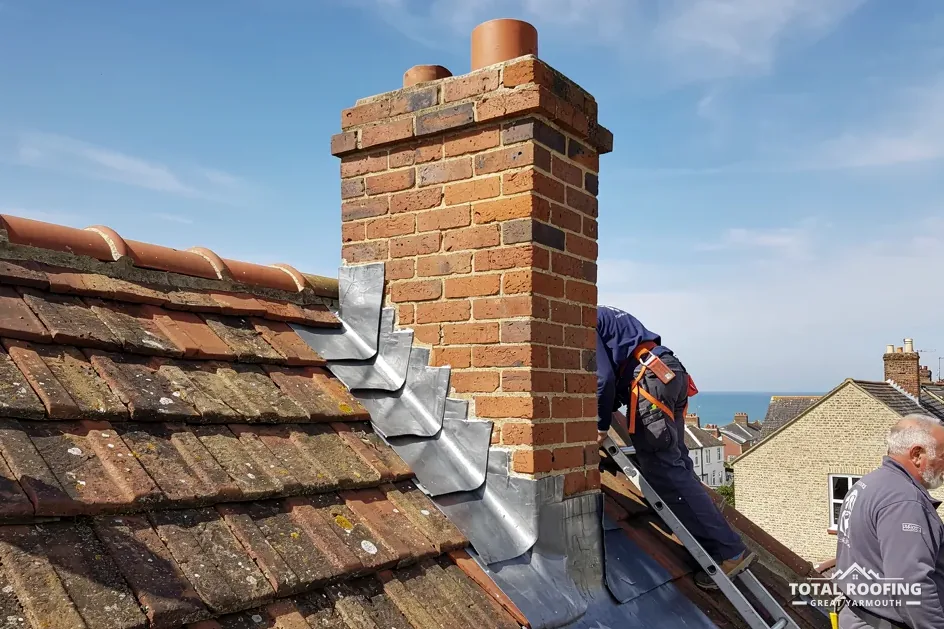
- Flashings: strips of lead or other metal sealing the joins at chimney stacks, side walls and roof windows. If one has lifted or its pointing has failed, wind-driven rain gets behind it.
- Laps and overlaps: where one tile, slate or sheet overlaps the next. A slipped or cracked tile opens a path.
- Valleys: the angled channels between slopes. In a downpour they carry the most water, and any blockage or crack in the lining sends it into the roof.
- Gutters and downpipes: if they cannot take the flow, they overflow and soak the eaves and the wall below.
A leak at the eaves that coincides with an overflowing gutter may be a gutter fault rather than a roof fault, and the repair is quite different. That is why the whole roof line needs to be looked at, not just the stain on the ceiling.
What to do while it is happening
Move what you can out of the way and catch the water. A bucket under the drip, a towel round it to stop splashing and a sheet over furniture will limit the damage. If a ceiling bulges with water, pierce it carefully with something small so the water drains into a bucket rather than bringing the plaster down all at once.
Photograph the ceiling, the floor and the stain before you move a thing, wet or dry. On storm complaints, the Financial Ombudsman Service says: "we'll usually look at expert reports and photos". It also says that "a storm usually involves violent winds, usually with rain, hail or snow", while "Rain, hail or snowfall by itself can constitute a storm". Tell your insurer, and keep the pictures.
Do not go onto a wet roof. A slippery surface at height turns a leak into an injury quickly, and no repair is worth that. Pictures from inside the loft, taken by torchlight, tell you more than anything you can see from a ladder in the rain.
Keep any damaged items, such as a stained rug or wet insulation, until the insurer has seen the pictures, in case they are asked for.
Costs and getting it seen to
MyJobQuote's page of 22 October 2026 gives a typical £150 to £300 for an emergency roofer's call-out, and adds that repairs after extensive storm damage can cost £1,200 or more. No VAT basis is stated. Those are the guide's ranges, not ours, and a price for your roof follows only once it has been surveyed.
At Total Roofing Great Yarmouth a survey goes over the entire roof, so the junction you were worried about is seen with everything around it. Any other fault gets pointed out in plain words, and the repair is quoted as a single written sum.
If you would like a first opinion, a picture of the stain or the loft can go to 07880 284133 on WhatsApp. For a wider view of repair work see our roof repairs page, and for the numbers, roof repair cost.
If the roof is not safe to work on in the rain, a temporary measure may be all that can be done on the day, and the lasting repair follows once the weather allows.
