
The short answer
You may repair your own roof, but a fall from height is the main risk, and some roof surfaces cannot carry a person's weight. Looking from the ground is safe, but going onto the slope is where a small job turns dangerous.
What you can check without leaving the ground
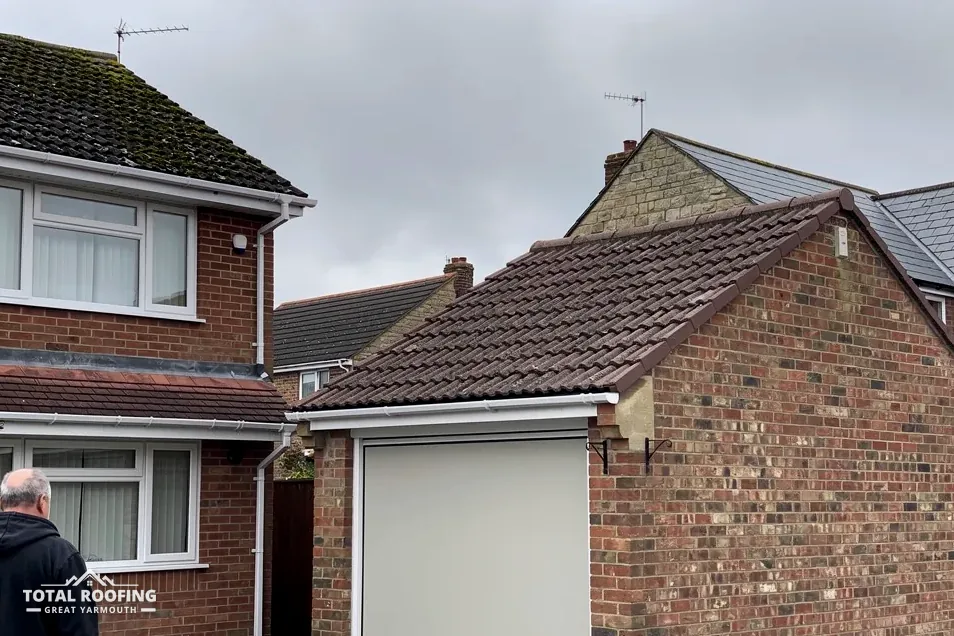
A first inspection needs no ladder at all. Stand in the garden, or across the road, and look along each slope. A slipped tile shows as a gap, or a tile sitting lower than its neighbours. A broken one shows as a dark patch. Binoculars, or a phone zoomed in, bring the ridge, the chimney and the lead flashing close enough to judge.
Look at the ground below the eaves too. Fragments of tile or lumps of old mortar in a flower bed or on a path mean something has come loose above. Check the gutters for plant growth, and the walls beneath them for green or dark stains, which show water running where it should not.
Inside, a torch in the loft shows daylight where a tile has gone, and damp patches on the timber and underlay. Keep your weight on the joists, or on boards laid across them, and off the ceiling between. Our guide to how to find a roof leak traces the route water takes, which does not run in a straight line below the hole.
Why the roof itself is the hazard
A roof is a sloping surface, wet after rain, sometimes slimed with moss or lichen, and well above a hard landing. A ladder leaned against a plastic gutter can slide or crush it, and stepping from the ladder onto the slope is the moment a slip can start a fall. Wet tiles, frost and a gust of wind all take the footing away at once. That is why roofing counts as work at height.
Then there is what the roof is made of. HSE's guidance on asbestos cement sheeting is blunt: "AC roofs are always fragile". HSE also says, "If the building was built or refurbished before 2000, assume that there is asbestos in it". A garage, outbuilding or older extension may be sheeted in that material, and stepping on it risks a fall through the roof and a release of fibres. Rooflights and conservatory roofs can give way underfoot as well.
- Do not put weight on any sheeted roof you cannot identify.
- Do not climb onto a wet, frosty or mossy slope.
- Do not work alone at height, or from a ladder that is not tied or footed.
Scaffold, rules and what lives in the roof
Anything above a single storey that needs more than a ladder wants scaffold. A scaffold standing over the pavement or road needs a highway licence from the county council. We arrange the licence with our scaffolder, but a homeowner who hires scaffold directly has that licence to sort out too, so a small repair can pick up a long list of extra steps.
Under the Planning Portal's guide, no building regulations application is normally needed when "Less than 25 per cent of the total 'building envelope'" is affected and "Less than 50 per cent of the roof is affected". A few tiles sit well inside both limits; a whole slope does not. A new covering "15 per cent or more" heavier is a separate matter, and the Portal advises a check with a structural engineer or surveyor before work begins.
Wildlife law can reach a repair. Where bats are present, GOV.UK counts "repairing or replacing a roof" among the jobs needing a Natural England licence. It is also an offence to intentionally damage the nest of a wild bird while that nest is in use or being built. If you find a nest or droppings under the tiles, stop before you carry on, and read our page on slipped roof tiles for what to do while a tile is loose.
When a roofer is the safer call
Published prices give a sense of scale. Which? Trusted Traders put the cost of replacing a handful of tiles, one to six of them broken or missing, at £75 to £400, excluding VAT (November 2025). Separately, MyJobQuote puts a roof repair at around £650 on average (6 October 2026). These are third-party ranges, not our prices, and they are worth setting beside the cost of a fall, a crushed gutter or a repair that fails because the cause was never found.
The gain from a survey is that the whole roof gets looked at, not only the tile you spotted. We survey before we quote, tell you plainly what we found and what else we saw, and give one written total price. Our roof repair cost page lays out the published ranges by job.
If you want a second opinion before deciding, message a photo to 07880 284133 on WhatsApp, and a roofer can read it for you. The other topics sit on our roof repairs hub.
