
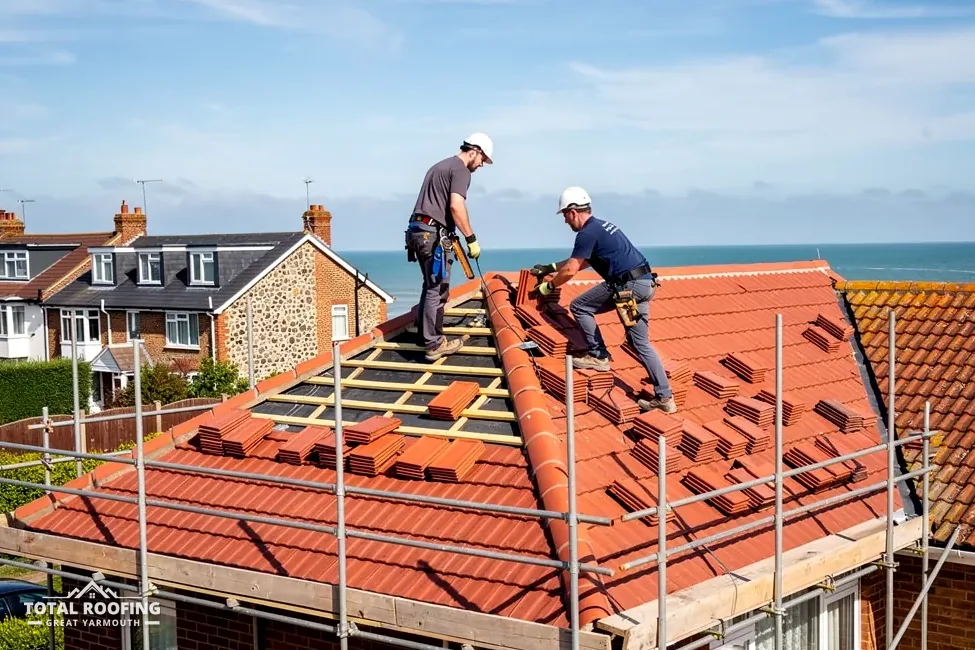
Ten questions that separate a repair from a replacement
A roof is a layered structure, and the tiles you can see are only the top layer. Underlay, battens and rafters lie beneath them, and any one of those can be sound while another is not. A decision to patch or to start again rests on all the layers, so the questions below follow the roof from the outside in and then widen out to the rules and the money.
- How old is the covering, and what is it?
- How large an area of the roof is affected?
- Has the same spot been repaired before?
- What state is the underlay in?
- Are the battens sound?
- Are the fixings holding?
- Would the work cross the Building Regulations line?
- Would a new covering change the weight?
- What do the published costs say?
- How long will you be in the house?
None of them has a yes or no answer that works for every house, and a single answer does not settle the matter alone. The pattern across all ten counts. A roof that answers well to the early questions can be repaired and left, and a roof that answers badly to several is asking for more than a patch. A survey looks at the whole roof for this reason, and not only at the leak you rang about.
Use the list as a way of preparing for that survey. If you can answer some of the ten before anyone climbs a ladder, the conversation with a roofer is shorter and the written quote describes the right job. The sections that follow take the questions in turn, and the table near the end gathers the findings and what each one points towards.
Questions 1 to 3: age, extent and repeat repairs
Age comes first because every covering has a published lifespan range, and a covering that is close to the top of its range strengthens the case for replacement. HomeBuilding, last updated on 30 September 2025, gives approximate lifespans of 100+ years for Welsh slate, 60 to 80 years for clay tiles and 40 to 50 years for plain concrete tiles. Marley quotes around 60 years for roof tiles, with its own caveat that the figure promises nothing about a particular roof. Age on its own is a pointer, not a verdict.
Extent is the second question. A few slipped or cracked tiles in one corner are a repair. Damage spread across a slope, or across more than one slope, is a different job. When you look from the ground, count the places, note whether they are together or scattered, and see whether any slope looks uneven. Our guide to slipped roof tiles covers the single-tile case.
The third question is about history. A leak that was fixed and has come back in the same place tells you that the cause was not the tile that was replaced. It may be the flashing, the underlay, a batten or a gutter, and a second patch on the wrong thing is money spent twice. If repairs keep following each other, ask the roofer to look for one cause behind them across the roof, and not to treat each leak as new.
Questions 4 to 6: what lies under the tiles
Underlay is a sheet membrane fixed across the rafters, with the battens over it. It catches water that gets past the tiles, and it ages out of sight. If you can get into the loft with a torch, look at it from below: gaps, tears, sagging or daylight are all worth noting. Do not walk on anything that is not a proper floor, and keep your weight on the joists.
Battens are the timber strips the tiles hang from, and the nails or clips that fix the tiles to them are the third item. A batten that has softened will not hold a nail, and a nail that has corroded will not hold a tile. Either can leave tiles that look fine from the street and are in fact loose. The sign from the ground is a slope that has started to look wavy, or tiles that have moved out of line.
These three are where repair and replacement diverge. New tiles on perished underlay and soft battens are a short-term fix, because the layers beneath will fail again. Where the sound parts can be kept, a repair or a re-lay makes sense. Where the layers under the covering have gone, a replacement is the repair, because it renews all the layers at once. Our page on what a roof inspection covers lists what is checked.
Myth
If the tiles look fine from the street, the roof is fine.
Fact
Underlay, battens and fixings sit out of sight and age separately from the tiles.
Questions 7 and 8: Building Regulations and weight
A building regulations application is normally not needed for re-roofing, on the Planning Portal's test, where "Less than 25 per cent of the total 'building envelope'" is affected and "Less than 50 per cent of the roof is affected". Both limits apply together. The envelope is the walls, floor, roof, windows and doors of the building, so the first limit is less than 25 per cent of all of that, and the second is less than 50 per cent of the roof alone.
Stripping the entire roof and re-covering it touches well over 50 per cent of it, which takes the job outside that test whatever the covering is. The route is then to check with your council's building control team, or with a registered building control approver, about what is needed. A small repair inside both limits is the case the test describes.
The second question is weight. Another trigger in the Planning Portal's guide is a weight increase of 15 per cent or more in the new covering, and the guide recommends a word with a structural engineer or surveyor first. Approved Document A treats a roof load increased by more than 15% as a significant change. Neither document names a material, so a switch of covering cannot be passed or failed from a description alone: the weights of the old and new coverings are set side by side before a decision is made. Where a repair keeps the same covering, the question does not arise.
Question 9: what the published costs say
These are third-party figures, dated, and they are not our prices. The written quote after a survey is one total price. They show the gap between a repair and a replacement and nothing more, because a real roof is priced from its own size, access and condition.
On the repair side, Which? Trusted Traders give £75 to £400 for putting right up to six broken or absent roof tiles, from a poll of 11 traders in November 2025, excluding VAT. Separately, MyJobQuote's 2026 repair guide, page dated 6 October 2026, has the average roof repair at around £650. On the replacement side, Which? gives £7,000 to £21,000, excluding VAT, for replacing the whole roof of an average three-bedroom house. MyJobQuote separately gives the average new roof at around £5,250 across the UK, on its page of 3 November 2026, and states no VAT basis for either of its figures.
HomeBuilding, updated on 30 September 2025, says a 65 m² roof in plain concrete tiles on a semi with three bedrooms may cost between £10,000 and £15,000, and that the same house in Welsh slate might reach £18,000. The four guides sit well apart, and they are for reading as ranges and not as predictions, whatever the roof in question. For the detail of repair pricing, see our guide to roof repair costs.
Repair and replacement, published
| One to six tiles (Which?, Nov 2025) | £75 to £400 |
|---|---|
| Average repair (MyJobQuote, Oct 2026) | around £650 |
| Whole roof, average three-bed house (Which?, Nov 2025) | £7,000 to £21,000, average three-bedroom house |
| Average new roof (MyJobQuote, Nov 2026) | average, around £5,250 |
Which? figures exclude VAT and the whole-roof band is for an average three-bedroom house. MyJobQuote states no VAT basis.
Question 10: how long you will be in the house
The last question is personal, and it changes the sums. Only you can answer it, because it depends on your plans for the house rather than on the roof. A repair that buys several years is good value for a household that plans to move on. A household that plans to stay for decades may find a replacement the cheaper route in the long run, because the same repair bill, paid again and again, adds up to more than one planned job.
Selling is a third case. A buyer's surveyor will look at the roof, and a roof with a history of patches or an open leak can come up in the conversation about price. A roof in sound condition, even an old one, makes a calmer sale than one with an unknown fault. If you are weighing a sale in the next few years, ask the roofer which findings a buyer's surveyor would note, and whether a repair now would settle them.
Whatever the answer, the quote comes once the roof has been surveyed, and we say plainly what the survey found, including what else we saw while up there. Where the job needs scaffold, it is dealt with inside that single written total. A photo of the damage sent on WhatsApp gets a look first, before any survey is arranged.
Putting the ten answers together
The table lists findings a survey can turn up and which way each one points. It is a guide to reading a survey and not a formula, and a roofer who has seen the roof will weigh them together.
| Finding | Points towards | Reason |
|---|---|---|
| A few tiles cracked or slipped | Repair | Covering and layers beneath are sound |
| Same leak, repaired twice | Look for the cause | The fault is not in the tile |
| Soft battens, perished underlay | Re-lay or replace | Hidden layers have failed |
| Covering approaching the limit of its range | Replace, in time | Repairs only delay the job |
Read across the rows and the pattern shows: a roof whose layers are sound and whose damage is local is a repair, and a roof whose layers have failed is a replacement. Age sits between the two and tips the balance only when other findings agree with it. An old covering in sound condition, with firm battens and whole underlay, can be repaired for as long as it stays that way, and a young covering on rotten battens cannot.
Our hub page on roof repairs covers the full range of repair work, and the survey described above is the way to find out which row your own roof belongs in. Ask for the findings in plain words, so that you can set them against the ten questions yourself before agreeing to any price.
