
Call 01493 277103

Stratton Strawless, 26.1 road miles north-west

Roofers in Stratton Strawless

Stratton Strawless is a 36-minute drive from Great Yarmouth, 26.1 road miles to the north-west. Any roof job begins by looking over all of the roof, followed by a straightforward account of what turned up, and the council route for your address comes first.

Get a written quote

Call 01493 277103WhatsApp us

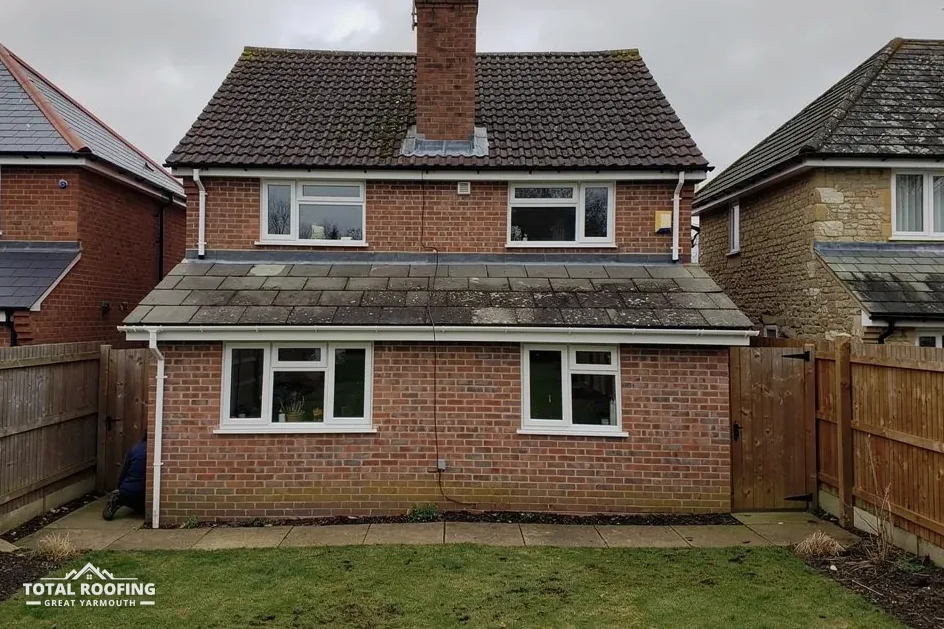
Rear tiled roof of a brick semi seen from the garden
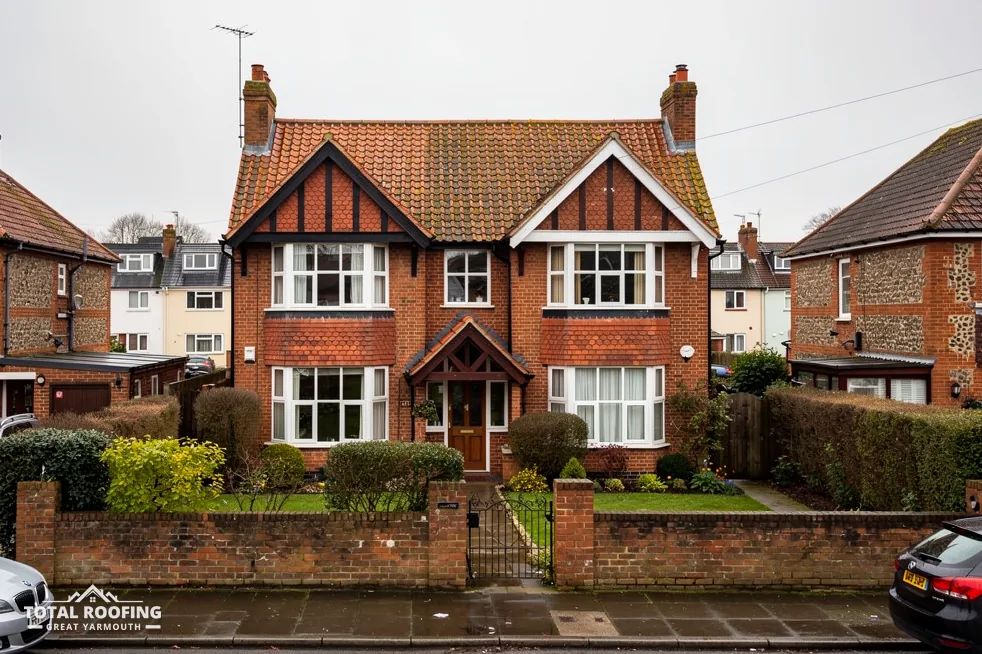
A large Edwardian brick house with tiled roofs and timbered gables

Church, listed pair and tombs in Stratton Strawless

  • St Margaret's, Grade I

    St Margaret's Church holds a Grade I listing (National Heritage List entry 1372972, first listed 10 May 1961). It is a Church of England church in the Diocese of Norwich, and that decides how work on its roof is approved.

    Houses around it are judged separately, by their own listing where they have one and by the planning position at their address. A roof survey reads the same parts in the same order on either kind of building.

  • Church Road and the churchyard

    1 and 2, Church Road is listed Grade II (entry 1372971, first listed 18 November 1980). Two Table Tombs Immediately South of St Margarets Church Tower are Grade II as well (entry 1250431). Five listed buildings lie nearby in all.

    Altering the character of a listed roof needs consent first. Put your own address to Broadland District Council, and the roof repairs survey goes ahead with that answer.

  • Checking your own address

    Whether your address falls inside a conservation area, or has an Article 4 direction on it, is a question for Broadland District Council. An Article 4 direction can remove further permitted development rights, so check with the council first.

    Broadland and South Norfolk's shared page counts 21 conservation areas within Broadland. In a parish of 557 usual residents, a neighbour's roof can have a different status from yours, and each needs its own check.

Stratton Strawless: the bodies behind a roof decision

  • Planning: Broadland District Council decides; the parish is outside the Broads executive area.
  • Building control: CNC Building Control, a partnership of five councils, working from Norwich.
  • St Margaret's, Grade I: faculty system via the Diocese of Norwich; outdoor planning rules stay separate.
  • For a particular address, check with Broadland District Council about conservation areas and Article 4.
  • Scaffold standing on or over the road: Norfolk County Council licence, which we arrange with our scaffolder.

The planning guide explains which roof jobs call for consent. Before work starts on a Stratton Strawless roof, the council route is confirmed.

Map of Stratton Strawless and the places nearest to it. Map tiles © Esri; map data © OpenStreetMap contributors.

Ask it straight · Stratton Strawless

A parish of 557: church, listings, asbestos and the re-roof test

Stratton Strawless parish had 557 usual residents at the 2021 Census. The four answers below cover the questions that shape a roof job in a small parish: which consent covers the Grade I church, how listed houses are treated, which rules govern asbestos cement, and when a repair stays outside building control.

Which consent covers a repair to St Margaret's Grade I roof?

The short answer

The Church of England faculty system, not listed building consent. Broadland decides planning permission for outside work separately.

The Church of St Margaret is Grade I (National Heritage List entry 1372972, first listed 10 May 1961). A Church of England church still in use is exempt from listed building consent, and the Diocese of Norwich handles its approvals through the faculty system instead. That applies to a lead valley, a new ridge or a patch of replaced tiles in just the same way. Smaller like-for-like repairs may go ahead on the archdeacon's written notice, while larger works need a faculty, and the diocese is involved first either way.

The exemption has edges. Exterior work may still require planning permission, and Broadland District Council decides it, while building control remains with CNC Building Control or a registered building control approver. A survey of a church roof takes in the tiles, the lead and the rainwater goods, then whatever else shows up, and each finding is set out for the churchwardens plainly.

The route belongs to the church building. The other listed entries in the parish, 1 and 2, Church Road, and the two table tombs by the tower, are separate listings of their own, and a listed house takes the ordinary consent route set out in the next answer. A parochial church council weighing up a roof repair has the same survey available as any homeowner.

What a church roof survey looks at

  • Covering: tiles or slates that have slid, split or gone
  • Leadwork: valleys, flashings and any gutters in lead
  • Rainwater goods at the eaves that carry the run-off away
  • Roof timbers and underlay, seen from the inside

How does listing change work on 1 and 2, Church Road?

The short answer

Broadland grants listed building consent for work that would alter the pair's character. The survey itself reads the roof the same way.

1 and 2, Church Road is listed Grade II (National Heritage List entry 1372971, first listed 18 November 1980). Two Table Tombs Immediately South of St Margarets Church Tower are Grade II too (entry 1250431). Five listed buildings lie nearby altogether, so the three entries named here do not exhaust the list. Each entry has its own list number, which is how the council or Historic England finds it.

Consent is needed for work "in any manner which would affect its character as a building of special architectural or historic interest", and the local planning authority, Broadland District Council, grants it. One list entry covers both numbers in Church Road, so ask Broadland whether a repair to one side touches the character of the whole. Permitted development rights for roofs stay with listed homes, with the character test layered above them.

With or without a listing, the survey goes over the same ground: covering, ridge, verges, valleys, flashings, gutters, then the timbers from the loft. On a listed roof, each finding is explained in the light of the entry, so the owner can tell which of the fixes need consent and which fall short of it. Our survey does not depend on which route applies.

Church or house

St Margaret's church

  • Faculty system
  • Grade I
  • Diocese of Norwich

Church Road houses

  • Listed building consent
  • Grade II
  • Broadland decides

Which rules govern asbestos cement sheets on a Stratton Strawless garage?

The short answer

HSE treats carefully removed, unbroken sheeting as non-licensed work. Norfolk's recycling centres take no asbestos, so a lockable skip holds the waste.

Start from HSE's quoted rule of thumb: "If the building was built or refurbished before 2000, assume that there is asbestos in it." Garages, sheds and porches from before that date can carry cement sheets on the roof, cement rainwater goods, or insulating-board panels under the eaves, where HSE lists "AIB white soffit panels to underside of roof eaves".

The class of work depends on condition. Asbestos cement, as in roof sheeting and rainwater goods, falls in the non-licensed group "provided the material is carefully handled/removed without breaking up". Once it is "substantially damaged or broken up (eg as a result of fire or flood damage)", it becomes notifiable non-licensed work (NNLW). Most work on asbestos insulating board (AIB) is licensed. HSE's guidance also says "AC roofs are always fragile". The survey notes which parts of the roof are cement sheet or board, and which are not.

Norfolk County Council does not accept any asbestos at its recycling centres, and recommends a specialist contractor, so a household in the parish has no council site for the sheets. HSE says "it is not good enough to throw sheeting over a standard skip", and the household consignment-note exemption covers hazardous waste "other than asbestos waste". HSE points out that asbestos may sit hidden inside the building fabric as well as in plain view, so the class of work is settled before anything is cut or lifted.

How an asbestos question is settled

  1. Where a building was built or refurbished before 2000, assume asbestos is there.
  2. Judge a sheet from the ground, never from the roof.
  3. Decide the class: non-licensed, NNLW or licensed.
  4. Waste goes in a lockable skip, not to a recycling centre.

Is a patch repair on a Stratton Strawless roof outside building control?

The short answer

A small repair normally needs no building regulations application if it stays under both Planning Portal limits. A full re-roof needs one, whatever the covering.

For building control, Stratton Strawless addresses go to CNC Building Control, a partnership of five councils (South Norfolk, Norwich City, Broadland, King's Lynn & West Norfolk and Fenland); ring 0808 168 5041 for its Norwich office, or choose a registered building control approver. For re-roofing, the Planning Portal's test is that no building regulations application is normally needed where "Less than 25 per cent of the total 'building envelope'" is affected and "Less than 50 per cent of the roof is affected".

A few tiles swapped for matching ones sit well inside that test. Stripping the whole covering does not, because it affects more than 50 per cent of the roof, and the job then belongs under roof replacement. The two limits apply together: meeting only one of them still leaves the job needing an application, so both are checked against the planned work.

Weight has its own threshold. Approved Document A's wording for a significant change is "the loading upon the roof is increased by more than 15%", while the Planning Portal says approval is needed at 15 per cent or more. Either way, a heavier covering goes to a structural engineer or surveyor before work begins, and the survey looks at the timbers that would carry it. The timbers are looked at on every survey, whatever the size of the job.

Reading the Planning Portal test

  1. Work out what share of the building envelope the job affects.
  2. Work out what share of the roof the job affects.
  3. Ask whether a new covering is 15 per cent or more heavier.
  4. Take a heavier covering to a structural engineer first.

Stratton Strawless roofs: stains, scaffold, storms, conservatories, lifespans

A brown patch has spread over a ceiling corner in my Stratton Strawless house: is it the roof?

It can be. The stain marks where water ended up, and the source may sit elsewhere: a tile that has slipped, flashing that has failed or an overflowing gutter. The survey starts from inside the loft, then traces the line up to the covering. A photo sent to WhatsApp (07880 284133) gets a look from us, and the roof repairs service follows the survey. Photograph the mark and note the date, so changes can be compared.

Does a scaffold at my Stratton Strawless house need a licence?

Only if the frame stands on or over the highway. In that case it needs a section 169 licence from Norfolk County Council, which charges £178.33 for the first 28 days, then £178.33 again per further 28-day period, and asks for 7 calendar days to process an application. We arrange the licence with our scaffolder. A frame kept wholly within the plot falls outside the section.

What counts as a storm when my insurer rejects a roof claim?

The Financial Ombudsman Service gives its own test: "a storm usually involves violent winds, usually with rain, hail or snow", and "Rain, hail or snowfall by itself can constitute a storm." The same page makes the insurer prove that an exclusion applies. Photographs taken before anything is moved help, and the Ombudsman's number is 0800 023 4567.

Can I swap a Stratton Strawless conservatory roof for solid tiles?

A solid roof is possible, with building control involved from the start. The Planning Portal's wording: "A new roof must comply with building regulations to ensure it is structurally safe, energy efficient and properly ventilated." CNC Building Control or an approver is asked first. Planning permission may be needed if the roof's look changes substantially. See conservatory roofs.

How long should a new covering last on my Stratton Strawless roof?

HomeBuilding (updated 30 September 2025) gives approximate lifespans of 100+ years for Welsh slate and 60-80 years for clay tiles. Marley reports that "For clay roof tiles, the BRE determined a minimum life expectancy of 60 years". Neither figure speaks for a particular roof: the survey judges the covering in front of it, including its fixings and the condition of the underlay below.

Hainford, Buxton and neighbouring parishes

A Stratton Strawless roof quote

Tell us about your roof

10-year workmanship guarantee, in writing

Call WhatsApp Written quote