
Call 01493 277103

Lingwood, 11.5 road miles west

Roofers in Lingwood

Lingwood lies 11.5 road miles west of Great Yarmouth, an 18-minute drive. Every slope and the loft get looked at, you hear in everyday language what turned up, and we confirm with Broadland and CNC which planning and building control route applies before work gets under way.

Get a written quote

Call 01493 277103WhatsApp us

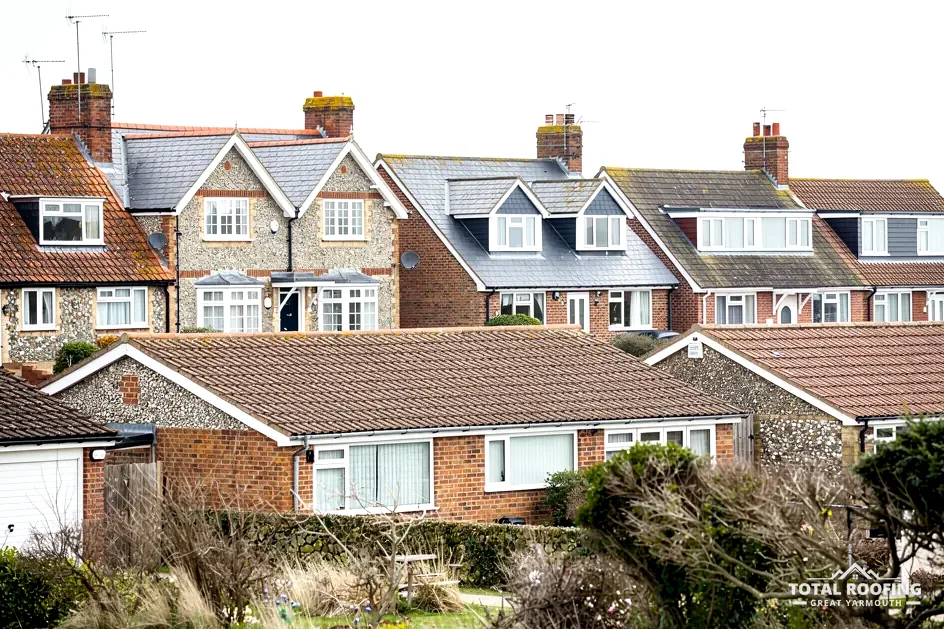
A row of low bungalow roofs on the flat land of the Selsey peninsula
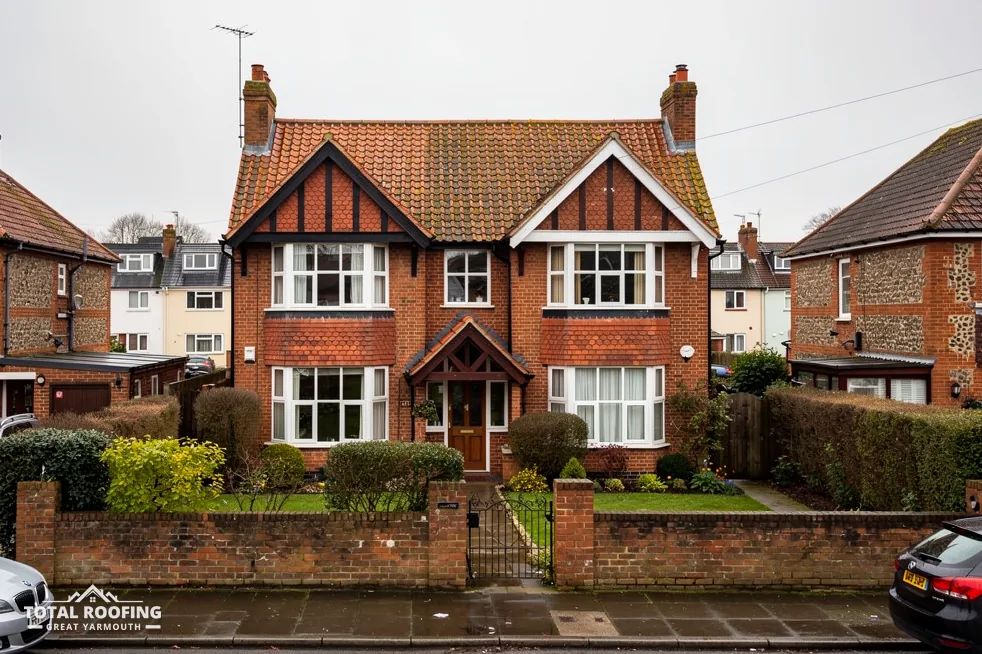
A large Edwardian brick house with tiled roofs and timbered gables

Two Grade I churches and a thatched cottage

  • St Peter's and St Edmund's

    St Peter's church is listed Grade I (National Heritage List entry 1051521, first listed 25 September 1962). The Church of St Edmund carries the same grade (entry 1152884). Eight listed buildings lie nearby altogether.

    Each church has its own consent route, and neither is assumed from the other. The roof survey is the same for both: covering, leadwork, gutters and the timbers carrying them, with each part explained plainly, whatever is decided about consent.

  • Thatched Cottage, Grade II

    Thatched Cottage is listed Grade II (entry 1051523, first listed 19 March 1985). Work that affects a listed building's character needs listed building consent, and CNC says building regulations may apply to repairs on a thatched building.

    Whatever sits on a rafter, the framing beneath it, the chimney flashing and the gutters are checked as part of the survey, and the owner hears which parts are sound before the council is asked anything.

  • Planning stays with Broadland

    Broadland District Council decides planning for Lingwood addresses. Ahead of any new covering or a cut-in roof window, put any conservation area or Article 4 question about the exact address to Broadland District Council.

    Flood risk attaches to each plot, not to the parish. GOV.UK's long-term flood risk service shows an area, and the flood map for planning is used for applications, so the check is made for your own address rather than for the village as a whole.

Who rules on Lingwood roofs

  • Planning: Broadland District Council decides, for every Lingwood address.
  • Building control: CNC Building Control, a five-council partnership working from Norwich, 0808 168 5041.
  • For a conservation area or an Article 4 direction at your address, ask Broadland District Council.
  • Church of St Peter, Grade I: faculty system. Thatched Cottage, Grade II: listed building consent.

The planning guide covers permission tests; before a Lingwood job starts, your route is confirmed with the council.

Map of Lingwood and the places nearest to it. Map tiles © Esri; map data © OpenStreetMap contributors.

Ask it straight · Lingwood

Lingwood roofs: two churches, a thatched cottage, party walls, contracts

Lingwood and Burlingham parish had 2,694 usual residents at the 2021 Census, a figure for the parish rather than Lingwood alone, since the civil parish takes in Burlingham as well as Lingwood, and the Grade I Church of St Edmund stands within a kilometre. The four answers below take in the churches, a thatched listed house, shared walls and the rights that come with a roofing contract. Strumpshaw, Blofield, Brundall and Acle sit nearest.

Which consent route covers the two Lingwood churches?

The short answer

St Peter's is a Church of England church in use, so faculty is its route. For St Edmund's, which shares its Grade I listing, ask the council which route applies.

St Peter's church is listed Grade I (National Heritage List entry 1051521, first listed 25 September 1962). A Church of England church in use falls within the ecclesiastical exemption, so its works are authorised by faculty rather than listed building consent. It lies in the Diocese of Norwich, and a faculty is how a parish gets leave for a covering to be replaced or its leadwork renewed, and the survey looks at its covering, lead and timbers in the same way as on any house.

The faculty system does not stand in for the other approvals, and a parish treasurer reading the faculty paperwork alone could miss the other two. Planning permission for exterior alteration is still decided by Broadland District Council, and building control stays with CNC Building Control or a registered approver. That makes three separate answers for a single roof, each from a different body, and the parish is told plainly what the survey found: what is failing, what is sound and what needs closer inspection.

The Church of St Edmund is also listed Grade I (entry 1152884). Whether it is still a church in use, and for which denomination, decides its route, so the consent route is confirmed with the council before work starts. It is the same safe course for any listed building: ask first, specify second, and let the survey say what is actually worn in the meantime. Our roof repairs page covers the smaller jobs that might arise.

Two Grade I churches

St Peter's

  • Faculty system, Diocese of Norwich
  • Planning still decided by Broadland
  • Entry 1051521

St Edmund's

  • Route to be confirmed with council
  • Grade I, entry 1152884
  • Survey identical to any roof

Do repairs to a thatched listed cottage in Lingwood need approval?

The short answer

Listed building consent applies to works affecting character, and CNC says building regulations may apply to repairs on a thatched building.

Thatched Cottage is listed Grade II (National Heritage List entry 1051523, first listed 19 March 1985). Listed building consent is needed for works "in any manner which would affect its character as a building of special architectural or historic interest", and the local council decides it. A different covering, a changed ridge or a new rooflight would each be put to Broadland first.

Building regulations are a second question. CNC Building Control's FAQ says: "If the repair work is significant, or the building is thatched then the Building Regulations may apply. However if the repairs are of a minor nature you will not need permission." Two separate triggers are named there, so a repair that is small on a thatched building can still need a conversation with CNC, and a repair that is large on a tiled one is judged by the Planning Portal's percentage test instead.

The timber and masonry around the covering belong to the same survey: the rafters, the wall plates, the chimney flashing and the gutters, all reported in plain words. Eight listed buildings lie nearby, so an owner is right to ask early whether a list entry reaches their address. The answer decides who is asked, not what the survey finds. Putting a question to the council is easier once every part of the roof has been named and its condition explained to you.

Myth

A small repair on a thatched Lingwood house never needs building control.

Fact

CNC says Building Regulations may apply where the building is thatched, even for repairs.

Does roof work on a Lingwood semi need a party wall notice?

The short answer

It can. Cutting into a party wall to insert a flashing, or cutting away a chimney breast, needs notice at least two months ahead.

The Party Wall etc. Act 1996 puts the duty on the building owner. Section 2(2) lists the work that counts as party structure work, covering the removal of part of a chimney breast, and cutting into an adjoining owner's wall "in order to insert a flashing or other weather-proofing". For that, notice goes out "at least two months before the date on which the proposed work will begin".

A neighbour can agree in writing, and then the work can start sooner. If no consent arrives "within the period of fourteen days", the neighbour is treated as dissenting and the matter becomes a dispute. GOV.UK warns against reading silence as agreement to the works. Dissent triggers the surveyor procedure of section 10, and the neighbour gets no veto, only a say in who surveys and on what terms.

New walls on or near the boundary work to a shorter clock: notice "at least one month before he intends the building work to start", and at least one month before excavation nearby. Party wall questions go to a party wall surveyor, rather than to building control. The roof survey notes where a flashing meets a neighbour's wall and where a chimney breast rises through the house, so the owner knows whether the question arises before a date is set.

How a party wall notice runs

  1. The building owner serves notice, two months ahead
  2. The neighbour can consent in writing
  3. Silence for 14 days counts as dissent
  4. Dissent opens the surveyor procedure, not a veto

What rights come with a Lingwood roofing contract?

The short answer

Within 14 days a contract signed at home can be cancelled; a visit you requested for an urgent repair is treated differently.

Signing at your own kitchen table after a survey makes it an off-premises contract. The Consumer Contracts Regulations say "the cancellation period ends at the end of 14 days after the day on which the contract is entered into". Starting inside that period needs your request in writing; making one does not take away your right to cancel, though any work already carried out may have to be paid for. Citizens Advice gives the same picture.

One exception matters for leaks. There is no cancellation right where "the consumer has specifically requested a visit from the trader for the purpose of carrying out urgent repairs or maintenance". A leaking valley on a wet night is an urgent repair; a planned re-roof signed at the kitchen table is not, and the 14 days then run in the ordinary way.

Whatever the contract, the Consumer Rights Act 2015 requires "Service to be performed with reasonable care and skill". For advice, ring the Citizens Advice consumer helpline on 0808 223 1133; it can also send complaint information on to Trading Standards, something a householder cannot do directly. Trading Standards does not advise individuals. A householder who cannot say whether a clause applies can ring the helpline before signing anything.

Contract terms for a roof job

  • Off-premisesSigned away from the trader's own business premises.
  • 14 daysCancellation period after the contract is entered into.
  • Urgent repairA visit you requested; no cancellation right.
  • Reasonable careThe standard the 2015 Act sets for a service.

Lingwood soffits, VAT, new-build cover, rooflights, duties

The soffit boards on my Lingwood house are white: could they hold asbestos?

They could. HSE lists "AIB white soffit panels to underside of roof eaves" among places asbestos insulating board turns up, and says "If the building was built or refurbished before 2000, assume that there is asbestos in it." Most work on AIB is licensed. Norfolk County Council does not accept any asbestos at its recycling centres. See guttering, soffits and fascias.

Will VAT reverse charge show on my Lingwood roof bill?

No. That charge only operates between VAT-registered businesses in the Construction Industry Scheme, covering supplies of services reported within the Construction Industry Scheme, so it has no place on a homeowner's bill. It is a business-to-business mechanism: a Lingwood householder has nothing to calculate or pay under it, and a roof quote carries no reverse-charge line.

A roof on my Lingwood new-build has a Buildmark: what does it cover?

NHBC's Buildmark cover is described as a builder warranty and NHBC guarantee for two years after completion and then eight years of insurance cover, in NHBC's own words. It is not a ten-year builder promise, and anyone planning roof work on such a house should read the cover's terms first, because it is the cover provider that interprets them and not the roofer.

How much is a rooflight swap in a Lingwood loft?

A standard mid-range Velux window averages £1,100 on MyJobQuote's figures, with a straightforward swap around £100 less since the opening is already in place (page dated 22 September 2026, no VAT basis stated). Approved Document L asks a replacement roof window to meet "1.4 or Window Energy Rating Band B minimum". See skylights and roof windows.

Is a construction phase plan required for re-roofing a Lingwood home?

Yes. Under CDM 2015 the contractor takes on a homeowner client's duties, or the principal contractor does if several firms work on the job, and no project is without a construction phase plan. In HSE's terms a Lingwood householder having a roof replaced is a domestic client, since the work is on their own home and not part of any business.

Lingwood quote request

Tell us about your roof

10-year workmanship guarantee, in writing

Call WhatsApp Written quote