
Call 01493 277103

Ditchingham, 20.1 road miles south-west

Roofers in Ditchingham

Ditchingham lies 20.1 road miles from Great Yarmouth, a 34-minute drive heading south-west. South Norfolk Council decides planning, CNC Building Control covers building regulations, and the full roof is surveyed before one written total is given.

Get a written quote

Call 01493 277103WhatsApp us

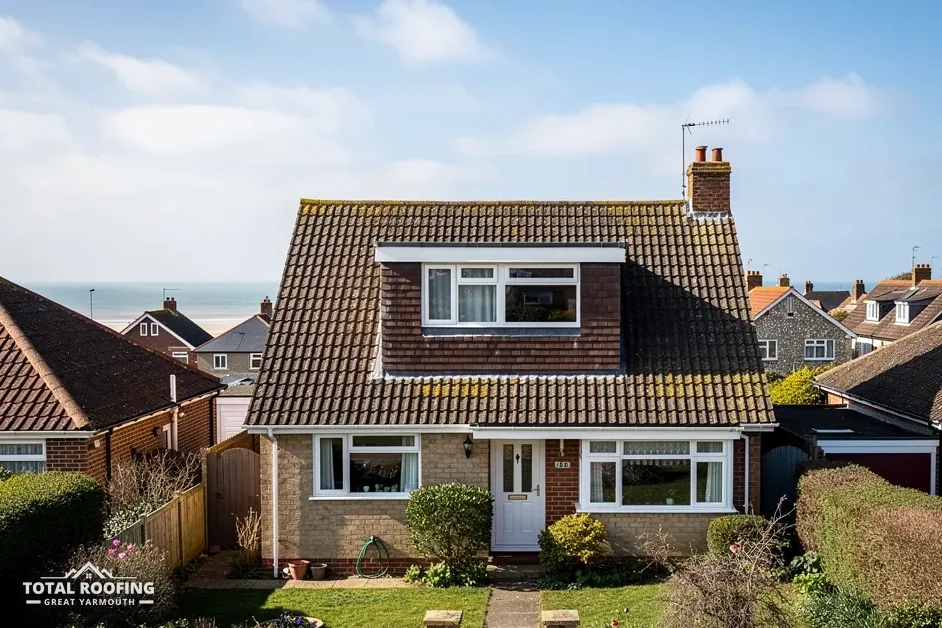
A dormer bungalow with a tiled roof and a box dormer
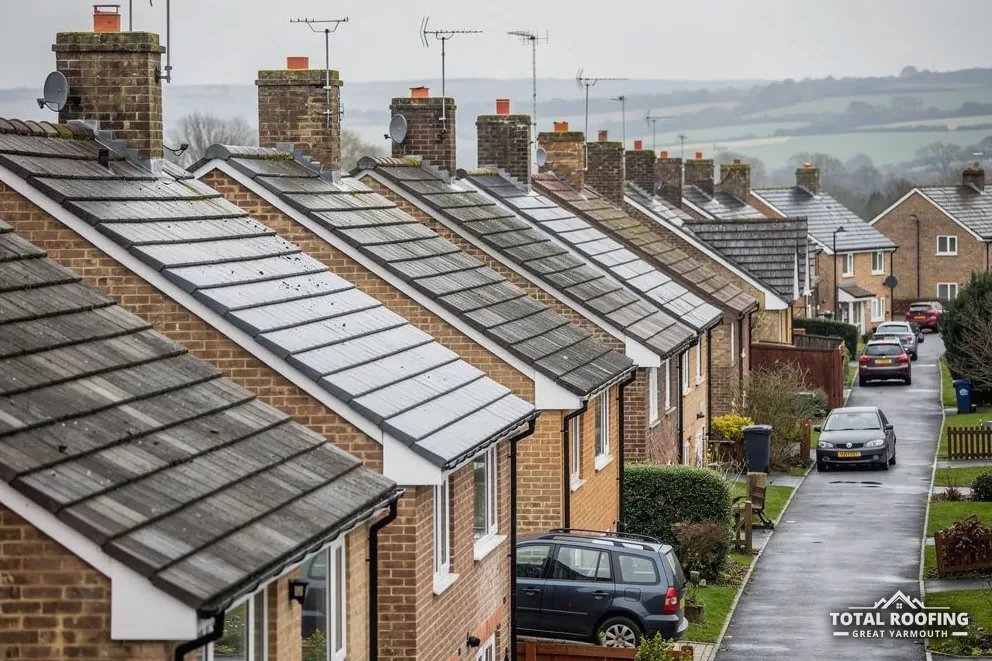
Modern brick estate houses with concrete tile roofs in a Wiltshire town

Ditchingham: Alma House, three streets, river edge

  • Scudamore Place and Windmill Green

    South Norfolk Council's Article 4 list has entries for 1-28 Scudamore Place, 1-30 Windmill Green, 25-39 Hallow Hill Road and 12-20 (evens) Thwaite Road, all dated 1989. Each council summary concerns the visible face of a dwelling-house and the grounds seen from the street.

    The council's table sets out a restriction for each entry. For any of these streets, and anywhere else in the village, check with the council whether an Article 4 direction applies before a covering is changed. Send the street name by WhatsApp to begin.

  • Alma House and its neighbours

    Alma House, including its boundary walls to north and south, is listed Grade II* (National Heritage List entry 1152917, first listed 25 September 1951). Numbers 1-28 Attached Screen Walls, Garages is Grade II (entry 1245411), and so is 25-39, Hollow Hill Road (entry 1245410).

    Nineteen listed buildings stand nearby, so these three are named examples. A listed roof has its covering, lead and ridge read in detail, and the survey looks at what is original before anything is proposed.

  • The river and marsh edge

    South Norfolk Council decides planning for Ditchingham. Land beside the river or on the marshes at the village edge can fall to the Broads Authority, so the address is checked before any roof application goes in.

    Flood risk is judged per site as well. GOV.UK's long-term flood risk service covers an area, not one house, and a roof survey cannot stand in for that check.

Ditchingham: council, edge land, CNC and listings

  • Planning: South Norfolk Council; land by the river or marsh can be Broads Authority land, so check.
  • Building control: CNC Building Control, a five-council partnership, 0808 168 5041.
  • Ditchingham has a conservation area designated by South Norfolk Council; ask about Article 4.
  • Alma House, Grade II*: ask the council. Grade II: 25-39 Hollow Hill Road and entry 1245411.
  • Scaffold across a pavement or road: Norfolk County Council licence, arranged with our scaffolder.

Permission tests sit in the planning guide, and a Ditchingham address is checked with the council before the route is settled.

Map of Ditchingham and the places nearest to it. Map tiles © Esri; map data © OpenStreetMap contributors.

Ask it straight · Ditchingham

Ditchingham roofs: edge land, listed houses, Article 4 and storms

Ditchingham parish had 1,823 usual residents at the 2021 Census. The four answers below cover which authority decides what at the village's river edge, how listed houses such as Alma House are handled, what the four Article 4 streets and a scheduled earthwork mean, and the order of events after storm damage. Over the river lies Bungay, and Earsham, Ellingham and Woodton have pages of their own.

Who decides planning at the edge of Ditchingham?

The short answer

South Norfolk Council decides planning in Ditchingham. Ground beside the river or marsh at the village edge may be Broads Authority land, so the address is checked.

Ditchingham sits outside the Broads executive area, and South Norfolk Council decides planning for its roofs. The boundary is close, though. Land by the river or on the marshes at the village edge can belong to the Broads Authority, whose planning team is on 01603 610734, so a house or outbuilding near the water has its address checked before any application is drawn up. Anything further in is South Norfolk Council's, with no Authority involvement.

Building regulations are a separate service. They go to CNC Building Control, a partnership of five councils (South Norfolk, Norwich City, Broadland, King's Lynn & West Norfolk and Fenland) responsible for this stretch of Norfolk, and Ditchingham enquiries reach its Norwich office on 0808 168 5041. A registered building control approver can be used in its place. Neither council nor Authority acts for the other on building regulations.

For the roof itself, the Planning Portal's two limits apply and a full re-roof breaks the second, so building control is involved. Roof enlargements have separate planning tests in the planning guide. Our part is to survey first and then ask the right body about your address, so that the written price rests on a route the council has already confirmed, and so that nobody finds out about a boundary after the old covering has gone. Where a house is plainly well inside the village, the answer is South Norfolk Council and the process is shorter.

Village and river edge

Village

  • Planning: South Norfolk Council
  • Building control: CNC

Riverside edge

  • May be Broads Authority land
  • Check the address first

How do listed houses such as Alma House change a roof job?

The short answer

A listed building needs consent for works that affect its character. South Norfolk Council gives that consent, and the survey comes before any proposal.

Alma House, including its boundary walls to the north and south, is listed Grade II* (National Heritage List entry 1152917, first listed 25 September 1951). Numbers 1-28 Attached Screen Walls, Garages carries a Grade II listing (entry 1245411) and so does 25-39, Hollow Hill Road (entry 1245410). Nineteen listed buildings stand nearby in all, which is why these are only examples.

The legal question for a listed building is whether works would act "in any manner which would affect its character as a building of special architectural or historic interest". For a roof, that reaches the covering, the ridge, the lead and sometimes the rainwater goods. The consent is given by the authority for the site: South Norfolk Council in the village, or the Broads Authority should a particular address prove to be on its land.

The practical order is simple. A survey of the roof says what is worn and what the repair needs, and the proposal then names the exact parts and materials, so the council has something specific to consider. Like-for-like repair and a change of covering are different conversations, and the council hears about the right one at the right time. For work on a house that is not listed, the same survey applies but the consent question is lighter.

Listed entries named in Ditchingham

  • Alma House with boundary walls, Grade II*, entry 1152917
  • Numbers 1-28 Attached Screen Walls, Garages, Grade II, entry 1245411
  • 25-39, Hollow Hill Road, Grade II, entry 1245410

Which Ditchingham streets carry Article 4 entries?

The short answer

Article 4 entries cover four streets; the council says what each removes. A scheduled earthwork is a separate consent system run through Historic England.

South Norfolk Council has designated the Ditchingham Conservation Area, and South Norfolk and Broadland's page says there are 52 conservation areas within South Norfolk. The Article 4 list for the village names 1-28 Scudamore Place, 1-30 Windmill Green, 25-39 Hallow Hill Road and 12-20 (evens) Thwaite Road, each from 1989, with council summaries that concern the exterior face of a house and the grounds in view of the street. A conservation area and an Article 4 direction are separate things. The survey of the roof itself runs the same way in any of them.

Each entry carries a restriction in the council's table, and the answer for a given house comes from the council. Check with the council whether an Article 4 direction applies to your address, and have it before a roof change is chosen. Owners in these four streets are the first to need to ask, though any address in the village can. Keep the council's reply with the quote once it arrives.

Earthwork on Broome Heath is a scheduled monument (National Heritage List entry 1003970). Works to a scheduled monument must be authorised, with the Secretary of State granting consent on an application made through Historic England. That has no bearing on an ordinary house roof, and the council does not give that consent. It is named here so nobody confuses the two systems.

Terms used in this answer

  • Conservation areaA designation made by the council
  • Article 4A direction that can remove permitted development
  • Scheduled monumentConsent comes through Historic England

What comes first after storm damage at a Ditchingham house?

The short answer

Photograph the damage untouched, then tell the insurer. A WhatsApp photo gives us a first view of the roof, and a make-safe can follow.

Keep your feet on the ground. Take a picture of the damage where it fell, with another picture of any ceiling stain indoors, and keep off the roof while you look. Then tell your insurer. The Financial Ombudsman Service says "a storm usually involves violent winds, usually with rain, hail or snow", and that "Rain, hail or snowfall by itself can constitute a storm", so a claim should not be dropped for want of high wind.

If a claim is disputed, the Ombudsman says it will "usually look at expert reports and photos", which is why the early pictures matter. A business has up to eight weeks to consider a complaint, and the Ombudsman can be approached within six months of the final response. The insurer decides the claim, and a photo sent to 07880 284133 on WhatsApp lets us study the damage before anyone comes out.

Emergency roofer call-out costs typically range from £150 to £300 in MyJobQuote's guide, which also says "extensive storm damage repairs can cost £1,200 or more" (page dated 22 October 2026, no VAT basis stated). Making safe comes first. The lasting repair is planned once the whole roof has been surveyed, so the one slipped slate that leaked is not all that gets looked at. See emergency roof repairs.

Storm damage: the order

  1. Keep off the roof and away from loose material
  2. Photograph the damage from the ground, untouched
  3. Photograph any stain or drip inside the house
  4. Tell the insurer, then message us a photo

Ditchingham ridges, scaffold, price checks, complaints and flood

Why can't mortar alone hold ridge tiles on a Ditchingham roof?

Marley says the 2015 amendments to BS 5534 made it clear that mortar "could no longer be relied upon as the only means of securing the roof covering", and that installing to BS 5534 "isn't required by law". BS 8612:2018 is the standard for dry-fixed systems at ridge, hip and verge. A ridge that has lost bedding or fixings shows at the survey. See roof repairs.

Does scaffold on a Ditchingham street need a licence?

Scaffold on a pavement or road needs a Highways Act 1980 section 169 licence, issued by Norfolk County Council. Norfolk County Council charges £178.33 for the first 28 days, repeated for each further 28 days, and its page asks you to allow 7 calendar days. We arrange the licence with our scaffolder, and scaffold sits inside the written price.

What does Checkatrade give for pitched roof repairs near Ditchingham?

Checkatrade's repair table (June 2026, exclusive of VAT) gives pitched clay tile roof repairs between £110 and £160 per m2, and natural slate repairs at around £190 per m2. They are per-m2 figures, which are rates rather than totals. The written quote after a survey is one total price. See pitched roofing.

What can I do if a Ditchingham roof job goes wrong?

Raise it with the firm first, in writing. For disputes with an insurer, the Financial Ombudsman Service is the route. For a dispute with a trader, the Citizens Advice consumer helpline on 0808 223 1133 is where individuals go for advice; Trading Standards is not set up for that. From 6 April 2026 the duty on traders over dispute resolution is DMCC Act 2024 section 308. Keep your written quote and your messages.

How do I check flood risk for a Ditchingham address?

GOV.UK's long-term flood risk service shows an area's risk from rivers, surface water, reservoirs and groundwater, but "it does not tell you how likely it is that an individual property will flood". Floodline is on 0345 988 1188. For a planning application, the Environment Agency's flood map for planning shows a site's flood zone. Riverside land at Ditchingham's edge is worth checking, because a roof job near the water can sit on land where the flood question matters to the planning side as well.

Ditchingham and the places beside it

Ditchingham: the written price

Tell us about your roof

10-year workmanship guarantee, in writing

Call WhatsApp Written quote