
Call 01493 277103

Bungay, 20.3 road miles south-west

Roofers in Bungay

Bungay sits 20.3 road miles away from Great Yarmouth, to the south-west, with Grade I buildings and land split between two planning bodies. Every job starts with a full survey and a check of whether the Broads Authority or East Suffolk Council handles the address.

Get a written quote

Call 01493 277103WhatsApp us

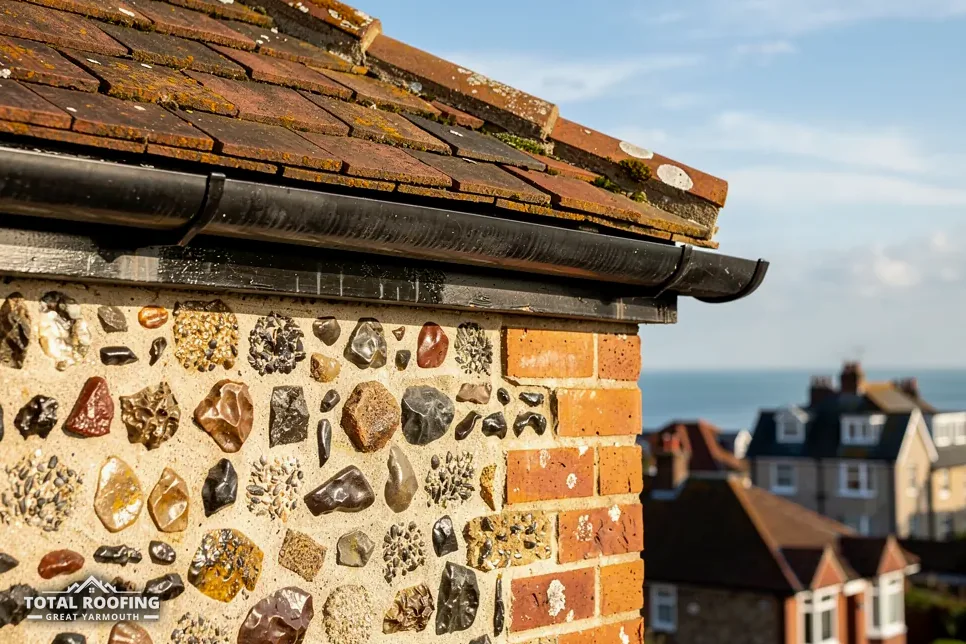
A flint and brick wall below the eaves of an old clay tile roof
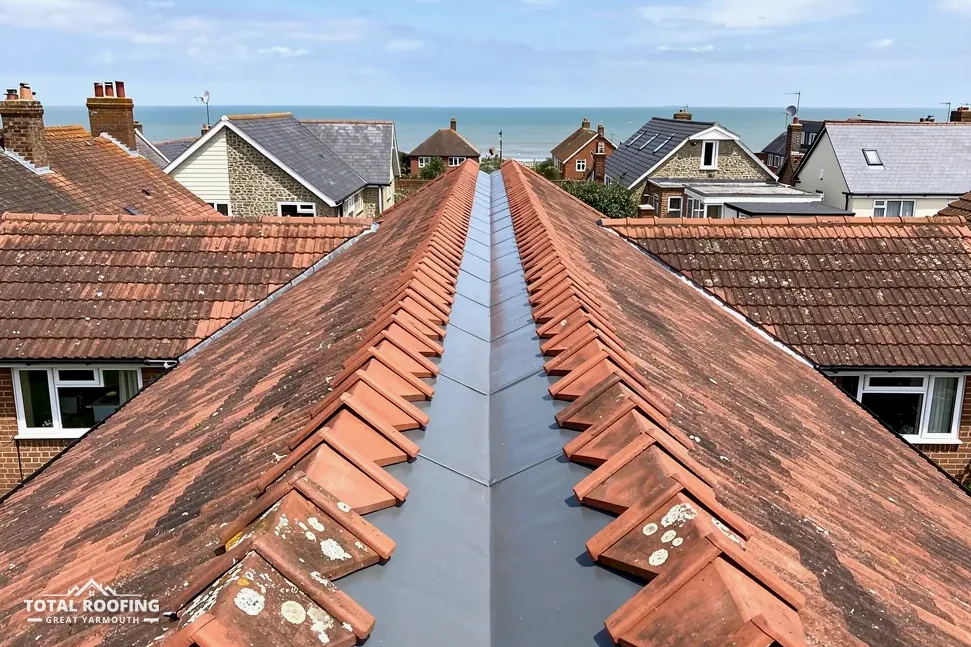
Lead-lined valley where two clay-tiled roof slopes meet

Holy Trinity, the Castle and the Broads edge

  • Bungay's Holy Trinity, Grade I

    The Church of Holy Trinity is listed Grade I (National Heritage List entry 1216997, first listed 9 May 1949). Church of England repairs go through the faculty system of the Diocese of St Edmundsbury and Ipswich, not listed building consent.

    A planning decision on the exterior is a separate step, taken by whichever body covers the address. The church roof is surveyed from ridge to eaves, lead and gutters included, with each finding explained in plain words.

  • Bungay Castle, Grade I

    Bungay Castle is listed Grade I (National Heritage List entry 1034404), and the Church of St Mary (including Ruins of Benedictine Convent) is listed Grade I at entry 1216850, first listed 9 May 1949.

    With 182 listed buildings nearby, a Bungay address is worth checking against the National Heritage List before any covering is priced.

  • Broads Authority land in Bungay

    The Broads Authority's executive area includes part of Bungay. For land inside that boundary, the Broads Authority, not East Suffolk Council, is the local planning authority, so the address decides who is asked first, and asking the wrong body first only sends the owner back to the start.

    East Suffolk Council's building control team, or a registered building control approver, handles building control wherever the house stands. That stays true on land the Authority governs for planning, because planning and building control are separate regimes with separate rules and separate officers.

Two planning bodies in one Bungay

  • Planning: the Broads Authority (01603 610734) inside its executive area, East Suffolk Council otherwise; check the address.
  • Building control: East Suffolk Council's team or a registered approver, even inside the Broads area.
  • Bungay Conservation Area is designated by East Suffolk Council; the Ditchingham Dam Conservation Area is also close by.
  • Broads Authority Article 4, its part of Bungay Conservation Area (1998): householder classes withdrawn.
  • Holy Trinity, Grade I: faculty system, Diocese of St Edmundsbury and Ipswich.

Our planning guide covers permission for roof work. For a Bungay address the route is confirmed with the right body before any job is agreed.

Map of Bungay and the places nearest to it. Map tiles © Esri; map data © OpenStreetMap contributors.

Ask it straight · Bungay

Bungay roofs: Broads Article 4, Holy Trinity, a scheduled cross, roof windows

Bungay parish had 5,010 usual residents at the 2021 Census, and its roofs answer to two planning bodies and a long list of heritage designations. These four answers take the Article 4 direction on the Broads side, the parish church, the scheduled monument at the centre of town, and what a new roof window has to achieve.

What does the Authority's Article 4 direction cover in Bungay?

The short answer

It applies to the Broads Authority's part of the Bungay Conservation Area, and it withdraws a list of householder classes, roof alterations among them.

The Broads Authority made an Article 4 direction in 1998 for its part of the Bungay Conservation Area. Its table lists householder classes under Part 1 and Part 2 of Schedule 2 of the General Permitted Development Order, roof alterations among them, and its note records that the table also covers demolition of walls, fences and gates. The direction is stated here for that area alone. Where it applies, a roof alteration that would otherwise be permitted development needs a planning application, which is the reason the address is checked first.

The rest of Bungay is different. Part of the town lies inside the Broads Authority's executive area, and for land inside that boundary the Authority is the local planning authority; it can be reached for planning on 01603 610734. Elsewhere in the town, East Suffolk Council decides. A house near the boundary is a matter of checking the address against the map before any job is priced.

Building control does not follow the same line. It stays with East Suffolk Council's team or a registered building control approver for every Bungay address, so a roof on land the Authority governs for planning still goes to the council for building regulations. The Authority has national park status and decides planning only, and it has no part in building control.

Two parts of one town

Broads part

  • Planning: Broads Authority, inside area
  • Article 4 direction of 1998
  • Building control: East Suffolk

Rest of town

  • Planning: East Suffolk Council
  • Check Bungay Conservation Area
  • Building control: East Suffolk

How are roof repairs at Holy Trinity, Bungay, authorised?

The short answer

The Church of England faculty system, with the Diocese of St Edmundsbury and Ipswich, in place of listed building consent. Exterior work still needs a planning decision.

The Church of Holy Trinity is listed Grade I (National Heritage List entry 1216997, first listed 9 May 1949). Holy Trinity belongs to the Church of England and is in use, so the ecclesiastical exemption applies and repairs go through the faculty system. Grade I is the highest grade, so any exterior change is weighed closely. The diocese for Bungay is St Edmundsbury and Ipswich, which is where a churchwarden's question about a roof begins.

The exemption takes listed building consent out of the picture and leaves planning alone. A planning decision on outside work comes from the planning authority for that address, which in Bungay can be either body, and building control is East Suffolk Council's team or a registered approver. Slopes, lead flashings and rainwater goods are all surveyed, and what turns up is explained in everyday terms.

Bungay's other Grade I buildings are the Church of St Mary (including Ruins of Benedictine Convent), entry 1216850, and Bungay Castle, entry 1034404. How roof work on either is consented depends on its status and use, so the route is confirmed with East Suffolk Council before any covering or lead detail is priced. With 182 listed buildings nearby, those three are examples. Stone parapets, lead gutters and old roof timbers each fail in their own way, so a patient survey comes before any figure.

Grade I buildings named for Bungay

  • Church of Holy Trinity, entry 1216997
  • Church of St Mary and convent ruins, entry 1216850
  • Bungay Castle, entry 1034404

Who consents to work on the scheduled Butter Cross in Bungay?

The short answer

Not the council. The Secretary of State grants consent for works to a scheduled monument, and Historic England takes the application.

The Butter Cross is a scheduled monument, National Heritage List entry 1006064. Works to a scheduled monument are controlled by section 2 of the Ancient Monuments and Archaeological Areas Act 1979. The Secretary of State grants consent; Historic England receives the application, so the council is not the body to ask.

That differs from the route for a listed house, where East Suffolk Council, or the Broads Authority inside its area, receives the application. A scheduled structure with roofing, lead or stonework in need of repair therefore starts its approval at Historic England, whatever size the repair is, and the survey simply describes the condition.

A roofer's part is limited to surveying the structure and describing the covering or the leadwork in plain words, so that the owner or the responsible body can make an informed application. Historic England's own list entry gives the scheduling details and the protected area, which is the first document to read. The Butter Cross is cited here by its entry number, 1006064, so the right record is found when applying. Whether a given repair needs authorisation is for Historic England to say, and no work on a scheduled monument should be priced as though consent were certain, because the consent comes first and the price follows it.

Myth

The district council consents to work on a scheduled monument.

Fact

Works are authorised under the 1979 Act, s2, by the Secretary of State.

What must a new Bungay roof window achieve under Part L?

The short answer

Part L 2021 sets 1.4 for roof windows or a minimum of Window Energy Rating Band B, and 2.2 W/(m²·K) for rooflights.

Table 4.2 of Part L (2021, England) sets the performance for new roof lights. A roof window must reach "1.4 or Window Energy Rating Band B minimum", and a rooflight 2.2 W/(m²·K). A supplier's data sheet states which figure each product meets, and that sheet is read before the window is ordered, because the rating is a condition of the building regulations. Cutting a roof window into a slope also touches the insulation line, so the rafter depth and the build-up are noted at the survey.

A roof window sits in the plane of the roof slope, and Part L gives rooflights their own separate figure. Both are cut into the structure, so the rafters, the trimming and the flashings round the opening are part of the job. Our skylights and roof windows page describes the types.

Where the address falls on land the Authority governs for planning, or inside a conservation area, ask the planning body whether the proposed windows need an application, and ask before a roof window is chosen, not after it has been delivered. Roof work near the Ditchingham Dam Conservation Area is a council question too. Building control, in every Bungay case, is East Suffolk Council's team or a registered approver, and the application is made before the opening is cut.

Roof window terms

  • Roof windowSits in the roof's plane; 1.4 or Band B.
  • RooflightGlazed unit with its own 2.2 W/(m²·K) figure.
  • WER Band BWindow Energy Rating minimum for roof windows.
  • TrimmingTimbers framing the opening in the roof.

Bungay roofs: slates, conservatories, urgent repairs, VAT, new-builds

A slate has slipped on my Bungay house: can it wait?

A slipped slate lets rain reach the battens and underlay beneath, and what happens there cannot be seen from the garden. Slates are held by nails or hooks, and a slipped one points to a failed fixing. Photograph it from the ground, note where it sits, and send the picture to 07880 284133. The survey then reads the slope around it for more loose slates and for corroded nails, and the roof is looked at as a whole, not as one slate.

How long does a conservatory roof last in Bungay?

HomeBuilding says polycarbonate has "a typical lifespan of 10 years". It quotes Roofing Megastore's managing director that glass "will likely last in excess of 30 years" and tiled "will typically last in excess of 50 years". The glass and tiled figures are the Roofing Megastore managing director's, as quoted by HomeBuilding, not HomeBuilding's own. These are published ranges, not a promise for a given roof. See conservatory roofs for the coverings.

I rang for an urgent roof repair in Bungay: can I cancel?

Urgent repairs are carved out of the 14-day right: the consumer has specifically requested a visit from the trader for the purpose of carrying out urgent repairs or maintenance. A contract signed at home after a survey is different, because it can be cancelled within 14 days. See emergency roof repairs for securing a roof that has taken damage.

Will a Bungay homeowner see the VAT reverse charge on a roof bill?

No. The construction reverse charge works between VAT-registered businesses and applies to supplies of services reported within the Construction Industry Scheme. It never appears on a homeowner's bill, since the reverse charge is about trade-to-trade supplies and a homeowner is the end customer. What we give a homeowner is a single written total price, reached after the survey, and the surveyor explains what is in it.

Does NHBC cover a roof defect on a new-build Bungay home?

NHBC describes Buildmark as "a builder warranty and NHBC guarantee for two years after completion and then eight years of insurance cover". Cover for one defect depends on the policy wording, so read the documents for the home and ask the builder or the provider in writing, with photographs of the roof.

Earsham, Ditchingham and Ellingham beside Bungay

A Bungay roof, one written price

Tell us about your roof

10-year workmanship guarantee, in writing

Call WhatsApp Written quote