
Call 01493 277103

Tacolneston, 29.3 road miles west

Roofers in Tacolneston

Tacolneston lies west of Great Yarmouth, 29.3 road miles and 41 minutes away. Every slope is surveyed and the findings told in plain words, and because the village has a conservation area, we check with the council which consents your address needs before any date is set.

Get a written quote

Call 01493 277103WhatsApp us

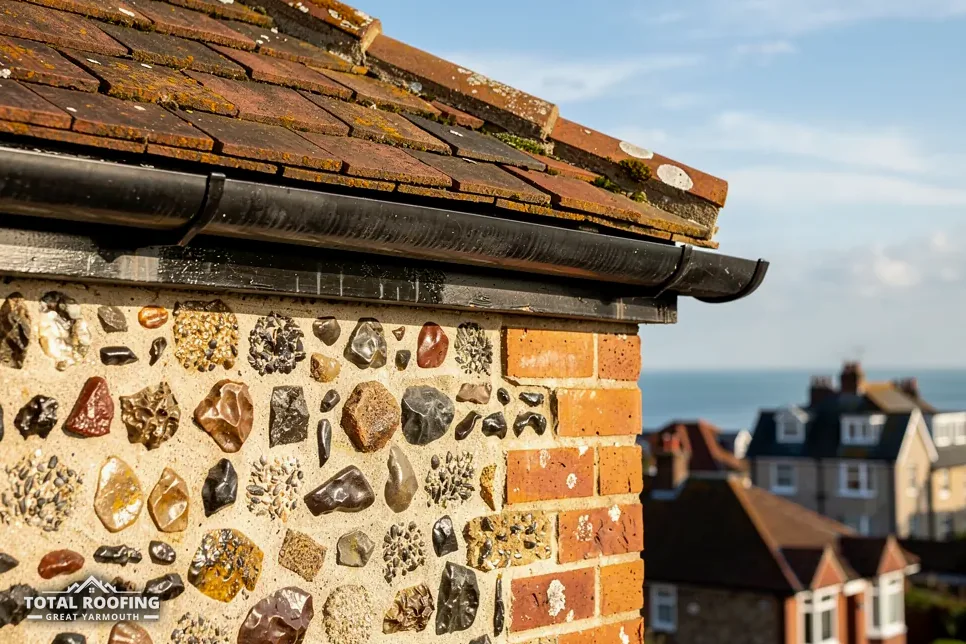
A flint and brick wall below the eaves of an old clay tile roof
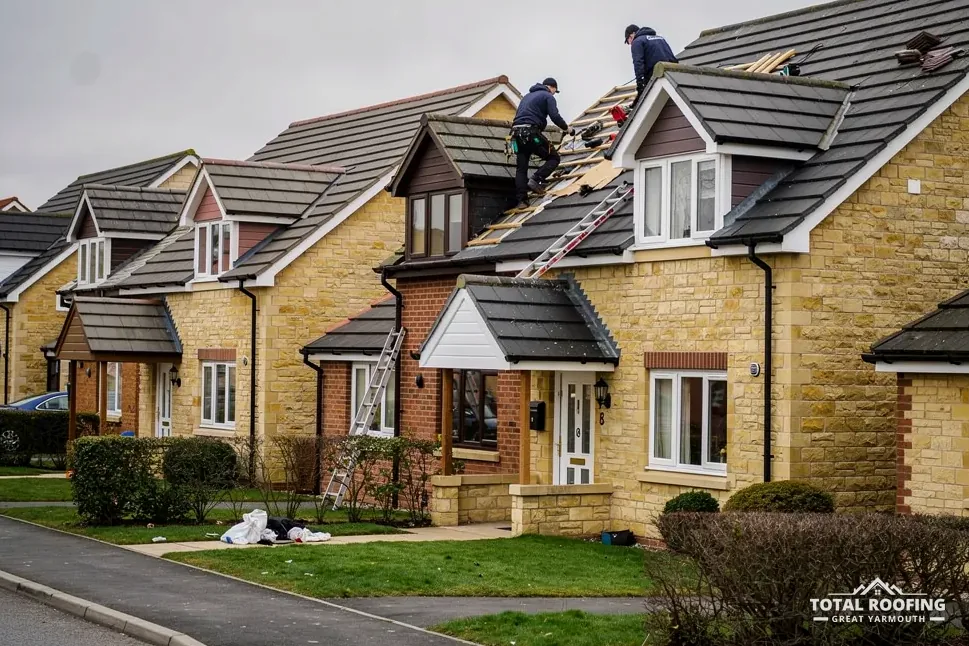
Roofers on a buff brick estate house with grey tile roofs

Norwich Road, the Hall and All Saints

  • Norwich Road, 126 to 134

    South Norfolk Council has designated the Tacolneston Conservation Area, and an Article 4 entry sits at 126 - 134 (evens) Norwich Road from 2008. The council's summary calls it "A row of clay lump properties important within the streetscape and conservation area."

    The council's table puts front boundaries and front-garden surfacing under that direction, not roofs, yet it is still worth asking whether an Article 4 direction applies before changing a covering or a roof window at any of those houses.

  • Manor Farmhouse and the Hall

    The Manor Farmhouse is listed Grade II* (National Heritage List entry 1050043, first listed 11 September 1951), and Tacolneston Hall is also Grade II* (entry 1050036). Houses of that size can carry several pitches, valleys and stacks, and each gets its own survey line.

    Thirty-two listed buildings lie nearby, so these are a few of many. Listed building consent from South Norfolk Council is the route for changes that affect character.

  • All Saints church, Grade I

    All Saints is a Grade I listing (National Heritage List entry 1178820, first listed 7 December 1959). Roof work at a Church of England church that is open for worship goes through the Diocese of Norwich faculty system.

    Whether work to the outside also needs planning permission is for South Norfolk Council to answer, and its decision is separate from the faculty. Our written price waits for both answers, so the owner is never quoted for work that a consent could later stop.

Tacolneston roofs: who decides what

  • Planning: South Norfolk Council decides; the Broads executive area does not reach Tacolneston.
  • Building control: CNC Building Control or a registered approver; CNC's Norwich office serves the village.
  • Conservation area designated by South Norfolk Council; Article 4 entry on Norwich Road, so check with the council.
  • All Saints, Grade I: Diocese of Norwich faculty, with outside work's planning question kept separate.
  • Scaffold above a footway or lane: Norfolk County Council licence, arranged through our scaffolder.

Our planning guide sets out when roof work needs consent, and we confirm the council route for your own house before a date goes in the diary.

Map of Tacolneston and the places nearest to it. Map tiles © Esri; map data © OpenStreetMap contributors.

Ask it straight · Tacolneston

Tacolneston roof questions: Article 4, All Saints, listed halls and lead

Tacolneston parish had 820 usual residents at the 2021 Census. The village has a conservation area, an Article 4 entry on Norwich Road and a Grade I church, so the four answers below start with who must be asked and end with the lead that keeps water out of old roofs.

Does the Norwich Road Article 4 entry affect my roof?

The short answer

Its stated restriction at 126 to 134 (evens) Norwich Road is front boundaries and front-garden surfacing, not roofs. Check with South Norfolk Council before any roof change all the same.

GOV.UK explains that an Article 4 direction "enables the Secretary of State or the local planning authority to withdraw specified permitted development rights across a defined area". Tacolneston has an entry for 126 - 134 (evens) Norwich Road, made by South Norfolk Council in 2008. Its summary describes "A row of clay lump properties important within the streetscape and conservation area."

The council's table gives the restriction as "Removal or erection of front boundary treatment and surfacing of front garden areas", which is not a roof control, and a written reply from South Norfolk is worth keeping with the deeds. For a house in that row, the sensible step is to check with the council whether an Article 4 direction applies before a covering is swapped, a roof window is added or a chimney is altered. South Norfolk and Broadland's page counts 52 conservation areas within South Norfolk, and the Tacolneston Conservation Area is one of them.

Houses elsewhere in the village are a separate matter, because a conservation area can reach further than one row of cottages. South Norfolk Council gives the answer for each address, and we put the question to it before the written quote is set, so the price reflects what is permitted. An owner who already holds a reply from the council can send it along with the first photograph. Replacing a covering, adding a rooflight and changing the pitch of a dormer are all worth asking about, because each alters how a street looks from the road.

Before touching a roof in the conservation area

  1. Ask South Norfolk about your address.
  2. Ask whether an Article 4 direction applies.
  3. Survey the roof as it stands.
  4. Written quote after the council's answer.

Who consents to roof repairs at All Saints, Tacolneston?

The short answer

The Diocese of Norwich, through a faculty, rather than listed building consent. Any planning permission needed outside the building is South Norfolk Council's to grant.

Entry 1178820 lists All Saints at Grade I, from 7 December 1959. The building is Church of England and still in use, which brings in the ecclesiastical exemption: roof work is approved by a faculty from the Diocese of Norwich, and listed building consent is not asked for. A parochial church council can raise the faculty with the diocese while the other questions are put.

That exemption lifts one consent and nothing beyond it. Where the outside work needs planning permission, South Norfolk Council decides it, and building control remains with CNC Building Control or a registered building control approver. Three offices, three questions, and a parochial church council can put them all on the same day without any one answer cancelling another.

Our survey of a church roof splits the building into parts. Nave, aisles, porch and any tower roof are examined one by one, with the lead, the downpipes and the roof timbers visible from the nave side noted for each, and the churchwardens are told what the survey found. A church roof has more gutter length and more lead than a house, so more of the survey is spent on it. Our lead roofing page explains the leadwork that church roofs carry.

Church and hall, two consent routes

Parish church

  • Norwich diocese grants a faculty
  • Grade I, entry 1178820
  • Planning still applies

Tacolneston Hall

  • Listed building consent
  • Grade II*, entry 1050036
  • South Norfolk decides

Which changes need consent at a listed Tacolneston house?

The short answer

Work that alters its special interest, as South Norfolk Council reads it. The grade of the building alone does not settle the question.

The Manor Farmhouse is Grade II* (entry 1050043, first listed 11 September 1951) and Tacolneston Hall is Grade II* (entry 1050036). Thirty-two listed buildings lie nearby, so a house here could well carry a listing, and the council can say which ones do. Listed status attaches to the whole building, roof and chimneys included, and it stays with the house when it is sold.

The legal wording is "in any manner which would affect its character as a building of special architectural or historic interest", and listed building consent follows from it. Recovering in another material, a rooflight in a front slope or a stack rebuilt in different brick can each change a house's character. A repair in matching materials is a milder matter, but the council still decides where the line falls, so ask it.

A large house brings roofs of different ages. The main roof, the wings and the outbuildings can each have a separate covering and separate lead, so each one gets its own finding. Where a valley or a parapet gutter fails, water can travel a long way through old timbers before it shows, which is why the loft is searched as well as the slope. A stain on a ceiling in one wing may begin in another, so the survey follows the water to its source.

Parts of a large house roof surveyed

  • Main roof covering and ridge
  • Wings and lean-to roofs
  • Valleys and parapet gutters
  • Stack flashings and pots
  • Loft timbers and underlay

Which lead code suits a Tacolneston flashing or valley?

The short answer

The specification sets it for each detail. Leadworx says code 4 has become the standard choice for general flashing work, and codes run from 3 to 8.

Lead sheet is sold by code, and the code is a thickness grade. Leadworx, a lead flashing maker, says codes 3 to 8 come from the LSTA and comply with BS EN 12588. In Leadworx's table, code 3 is for soakers and light duty, code 4 for light duty and general use, code 5 for general, vertical and pitched roofs, code 6 for large roofs, and codes 7 and 8 for heavy duty.

Leadworx also says "Code 4 has become the standard choice for general flashing work". That is one maker's statement of practice and not a rule, so a Tacolneston roof gets the code its details call for: a wide valley, a parapet gutter or a chimney apron may each want a different one. A thicker code costs more and weighs more, so the choice is made detail by detail, and a wide valley or a parapet gutter on a large house may want a heavier code than a small flashing beside a stack.

Correctly installed lead lasts well. MyJobQuote says lead flashing that is correctly installed "can last for over 80 years", and the same page mentions over 100 years for higher codes. Its price figures are for chimney leadwork only: a patch repair typically costs around £200, while a full replacement averages around £570.

Chimney leadwork, third-party figures

Patch repair, chimney leadaround £200
Full chimney lead replacementaround £570 on average (chimney)
Full chimney leadwork replacement£350 to £920 (chimney)

Source: MyJobQuote, page dated 22 September 2026. Covers chimney leadwork only, and states no VAT basis.

Tacolneston: verges, scaffold, storms, VAT and flashings

The verge on my Tacolneston roof has crumbled: what are my options?

A verge is where the covering stops at a gable end. Crumbled bedding lets tiles lift and water in. A dry verge system is the alternative to mortar, and MyJobQuote says installation "usually falls between £500 and £2,000", on a page of 8 October 2026. BS 8612:2018 is the standard for the dry-fixed alternative to mortar. Our roof repairs page covers the work.

What fee applies to scaffolding on a Tacolneston road or footway?

Norfolk County Council charges £178.33 for the first 28 days and £178.33 again for each later 28 days, and asks for 7 calendar days to process an application. Another licence application follows each fresh erection of the scaffold. We arrange the licence with our scaffolder, and the scaffold sits inside our one written total.

Wind has damaged my Tacolneston roof: can I claim on home insurance?

That is for your insurer to decide. The Financial Ombudsman Service says it "usually" looks at expert reports and photos, so photograph the damage before anything is moved and tell the insurer. We can look at a photograph sent to WhatsApp (07880 284133) and, where the roof is unsafe, make it safe.

Is there VAT relief on loft insulation at a Tacolneston house?

HMRC Notice 708/6 gives energy-saving materials a zero rate for supplies "made between 1 May 2023 and 31 March 2027", and insulation of "roofs or lofts" is within that notice. The reduced rate of 5% applies from 1 April 2027. Roof repairs and re-covering are not listed, so the relief is not assumed for them.

Do I have to tell my neighbour when a flashing is cut into our wall?

Yes, where the wall is a party wall. The Party Wall etc. Act 1996 lets a building owner "cut into the wall of an adjoining owner's building in order to insert a flashing or other weather-proofing", with notice served "at least two months before the date on which the proposed work will begin". Silence for 14 days counts as dissent, and the surveyor procedure then settles the matter.

Ashwellthorpe, Forncett St Mary, Wreningham, Tharston

Tacolneston roof, one written price

Tell us about your roof

10-year workmanship guarantee, in writing

Call WhatsApp Written quote