
Call 01493 277103

Felmingham, 26 road miles north-west

Roofers in Felmingham

Felmingham is 26 road miles from Great Yarmouth, heading north-west, a few miles from North Walsham. We climb up, look over covering, ridge and flashings as one roof, then say plainly what the roof needs and what else showed up.

Get a written quote

Call 01493 277103WhatsApp us

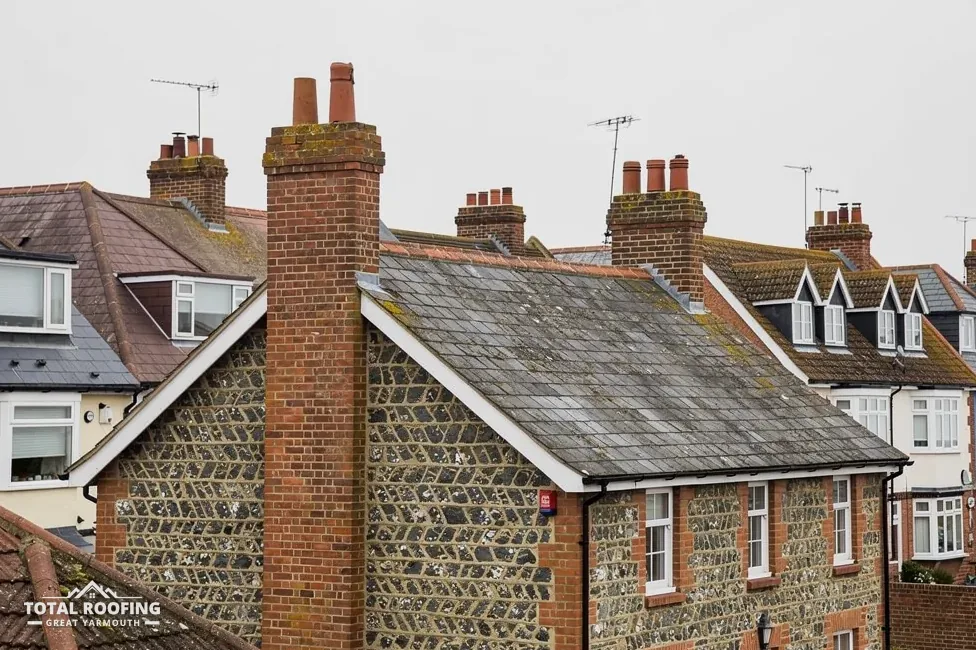
A flint and brick cottage with a grey slate roof
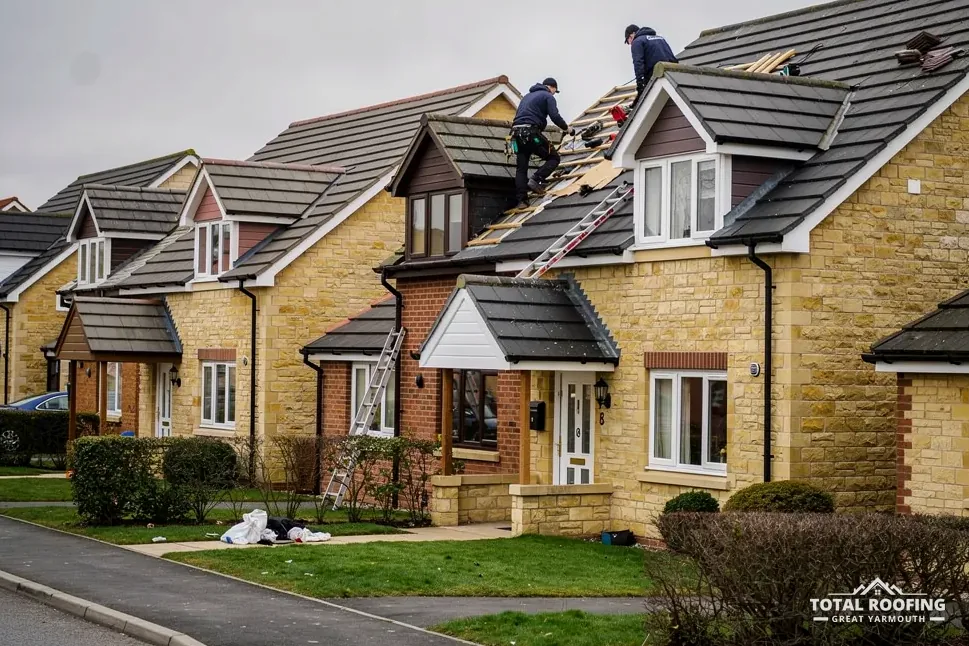
Roofers on a buff brick estate house with grey tile roofs

St Andrew's roof and the village lanes

  • The church of St Andrew

    St Andrew's church carries a Grade II* listing (National Heritage List entry 1049164, first listed 16 April 1955). A parish roof at that grade is cared for through the Church of England's own faculty process, so repair talk begins with the diocese, not with a planning form.

    A church roof still gets examined the way any roof does: the covering, the lead along gutters and valleys, and the timbers as seen from within. Whatever turns up is explained in everyday language, so members of the parochial church council who never see the roof can follow the repair.

  • Houses off the main road

    For a house in Felmingham, planning and building regulations both sit with North Norfolk District Council. A call before a re-roof starts saves a surprise later, and for a specific address the council can say what applies to it.

    Inspection of a house roof starts with the part you rang about and then travels outward: ridge, verges, valleys, flashings and gutters. Anything else seen gets reported, so the written price covers the whole roof as found, and you can decide what to do first and what can wait a season.

  • Farm buildings and outhouses

    Outbuildings and sheds on village plots raise one question first: what is the roof sheeted with? Corrugated cement from older buildings can contain asbestos, and the sheets are treated differently from tiles or felt from the very first step.

    A garage or workshop roof that has gone brittle is never walked on. Work from a roof ladder or a platform comes only after the material has been identified and the route for the waste has been settled.

Who decides on Felmingham roof work

  • Planning: North Norfolk District Council. Felmingham lies outside the Broads executive area.
  • Building control: North Norfolk District Council's own team on 01263 516345.
  • Church of St Andrew, Grade II*: faculty system via the Diocese of Norwich.
  • Scaffold on or over a road: Norfolk County Council issues the licence.
  • Flood risk is worked out site by site, using GOV.UK's flood tools.

For permission rules in general, read the planning guide; we check the route with the council before work begins.

Map of Felmingham and the places nearest to it. Map tiles © Esri; map data © OpenStreetMap contributors.

Ask it straight · Felmingham

Felmingham roofs: St Andrew's church, heavier coverings, nesting birds and a lane-side scaffold

Felmingham parish had 516 usual residents at the 2021 Census, and its roofs range from a Grade II* church to garden sheds. North Norfolk District Council decides its planning and runs its building control, while Norfolk County Council looks after the roads and the licences for anything built over them. The four answers below run in the order a job raises its questions.

Who signs off roof repairs to Felmingham's church?

The short answer

The Church of England faculty system, run through the Diocese of Norwich, in place of listed building consent. Planning for exterior work remains a separate step.

St Andrew's is listed Grade II* under National Heritage List entry 1049164, and it is a Church of England church in use. That brings the ecclesiastical exemption into play: where a house would need listed building consent, a church like this goes through the faculty system instead, and the Diocese of Norwich is the body that issues it.

The exemption stops at that one consent, and it goes no further. North Norfolk District Council can still require planning permission for exterior work, and building regulations go to the same council's building control team, so a tidy repair plan names all three bodies at the outset. Churchwardens commissioning work should expect three separate conversations, faculty, planning and building control, each covering its own slice of one roof.

Before any of that, the roof itself needs reading closely, because a parish quote built on a guess helps nobody. We look at the covering, the leadwork, the rainwater goods and the roof timbers from the outside and from within, then set out the findings in language a parish committee can follow, with one written total price for the repair once the survey is complete, however large or small the job turns out to be.

Terms a parish meets

  • FacultyWhat a diocese grants before church works.
  • ExemptionReplaces listed consent for Church of England churches in use.
  • Grade II*A listing above plain Grade II.
  • PCCThe parochial church council.

Can a Felmingham roof take a heavier covering without approval?

The short answer

Approval is needed once a new covering is 15 per cent or more heavier, and a structural check comes first. The material does not settle it.

Weight is the figure the Planning Portal watches, and it is a ratio, not a material. Approval is required when a replacement covering comes out "15 per cent or more" over the weight of what is there, and it advises asking a structural engineer or surveyor before work begins. Nothing in that guidance ranks one material against another, so no covering is ruled in or out here by name.

Rafters, purlins and wall plates carry the load, and the old covering tells you little about what they can bear. The survey includes a look from the loft: the timbers, the underlay, the battens and any sag along a slope, which shows whether the structure has been carrying its present weight without strain. Where the structure is in doubt, an engineer's view should come ahead of the order for tiles, since a covering cannot be unpicked once it has been laid across the whole roof.

Building control is the route either way, whether the roof is a barn, a bungalow or a two-storey farmhouse. North Norfolk District Council's own team takes the call on 01263 516345, and a registered building control approver is an alternative. For a whole-roof job read our roof replacement page, which sets out how a new covering goes on.

Myth

Swapping to a different covering never needs building control if it looks the same.

Fact

A covering 15 per cent or more heavier needs approval, whatever it looks like.

Is mortar alone enough to hold a Felmingham ridge tile?

The short answer

Not on its own. Marley says mortar could no longer be relied upon as the only means of securing the covering, though BS 5534 itself is not a legal requirement.

Ridge tiles sit along the highest joint on the roof, where wind can get at them from either side. Marley explains that, since the 2015 amendments to BS 5534, mortar "could no longer be relied upon as the only means of securing the roof covering". It also says that installing to the standard "isn't required by law", so it is the reference a specification follows rather than a legal duty in itself.

A ridge on a Felmingham house or barn can be held in two ways. Mortar bedding with mechanical fixings is one; a dry-fixed system tested to BS 8612:2018 is the other, covering ridge, hip and verge parts, with its own matched components and fixings. The survey looks at the bedding for cracks and shrinkage, at the tiles for movement, and at what sits underneath, so a repair is priced for the cause and not for the symptom.

That check is part of looking at the whole roof. A ridge that has rocked loose can go with open verges or tired hip ends, and those are seen from the same ladder. Afterwards the findings are laid out in everyday terms, ahead of the written total price, whether the work is a few tiles or the whole line.

What a ridge check covers

  • Bedding mortar: cracks, gaps and shrinkage
  • Tiles: movement, chips and open joints
  • Fixings: present, tight and corrosion-free
  • Verges and hips meeting the ridge

Where does a scaffold licence come from for a Felmingham lane?

The short answer

From Norfolk County Council as highway authority. We arrange the licence with our scaffolder.

A frame that stands on a road or pavement, or reaches out over one, falls under section 169 of the Highways Act 1980: nobody may "erect or retain on or over a highway" scaffolding without a licence. On a narrow village lane a run of boards projecting over the carriageway is caught by the same rule as a frame standing beside it, so the lean of the structure matters as well as its footprint. Where the frame must cross a driveway or a gateway, that is worked out at the survey, along with the delivery of materials.

Norfolk County Council is the licensing body, and its charge is £178.33 for the first 28 days, with a further £178.33 for each additional 28 days. Its page asks for 7 calendar days to process an application, and each new scaffold needs an application of its own, even on a house that has had one before.

Any frame a Felmingham roof needs is part of the one written total, and we arrange the licence with our scaffolder. On a lane without a footway the survey also looks at where the frame can stand clear of traffic, and at how tiles, sand and skips reach the house without blocking the road for neighbours.

Felmingham roofs: storms, sheds, foam and flood risk

A gale lifted ridge tiles on my Felmingham house: what next?

Take pictures from the ground before the debris is moved, then ring your insurer. The Financial Ombudsman Service explains that "a storm usually involves violent winds, usually with rain, hail or snow", and that it will "usually look at expert reports and photos". A picture sent to us on WhatsApp (07880 284133) gets a look, and the emergency roof repairs page covers the make-safe work.

My Felmingham shed roof is corrugated sheeting: is it asbestos?

Treat it as if it were. HSE says "If the building was built or refurbished before 2000, assume that there is asbestos in it", and "AC roofs are always fragile", so nobody steps on the sheets. Norfolk County Council's recycling centres are closed to it: the council does not accept any asbestos there, even during hazardous waste events. Cement sheets lifted out whole are non-licensed work, and waste goes in "a lockable skip for asbestos". Broken or crumbling sheets are notifiable work, so stop and ask first.

Will spray foam in my Felmingham loft cause trouble with a lender?

RICS reported "concern within specific sectors of the lending market, such as equity release mortgages" in March 2023. Government guidance of October 2026 says "Many mortgage providers are open to lending on properties with spray foam, subject to their own requirements", and that removal "will not always guarantee that they will still lend". Ask your lender and a specialist surveyor before deciding on removal, and see spray foam removal for how it is taken out. Unsolicited offers to remove foam are a known problem, so be wary of cold calls.

What fall should a Felmingham gutter have towards its outlet?

Brett Martin gives a fall of "1mm for every 600mm" towards the outlet. A gutter that is level, or tilted the wrong way, holds water and spills over the front at the joints. On the survey we sight along the run from a ladder and from the ground, and note any sag at the brackets or any joint that has opened, along with the downpipe that carries the water to the drain.

Can I check the flood risk for my Felmingham roof timbers?

The long-term flood risk service on GOV.UK describes an area: it does not tell you how likely it is that an individual property will flood. Floodline is on 0345 988 1188. For a planning application, the Environment Agency's flood map for planning is the tool to use. No flood zone is assumed for any Felmingham address, because the answer is worked out site by site.

North Walsham, Aylsham, Worstead and Scottow

Written price for a Felmingham roof

Tell us about your roof

10-year workmanship guarantee, in writing

Call WhatsApp Written quote