
Call 01493 277103

Easton, 28.6 road miles west

Roofers in Easton

Easton is 28.6 road miles from Great Yarmouth, heading west, and 37 minutes by road. Whether you ring about a leak or a re-roof, we survey every slope and tell you in plain words what we found, and the council route for your house is settled first.

Get a written quote

Call 01493 277103WhatsApp us

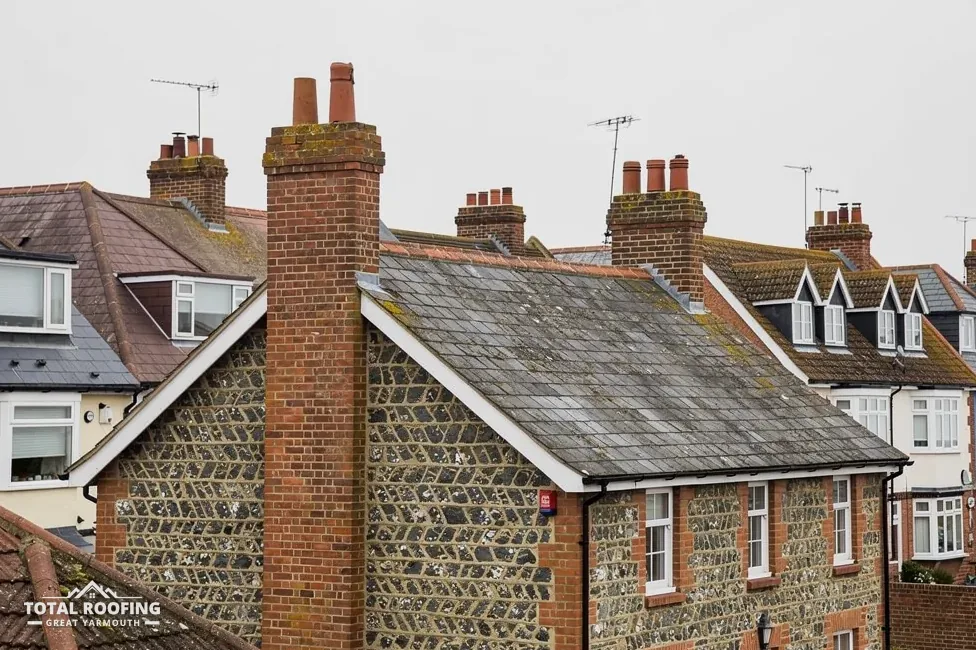
A flint and brick cottage with a grey slate roof
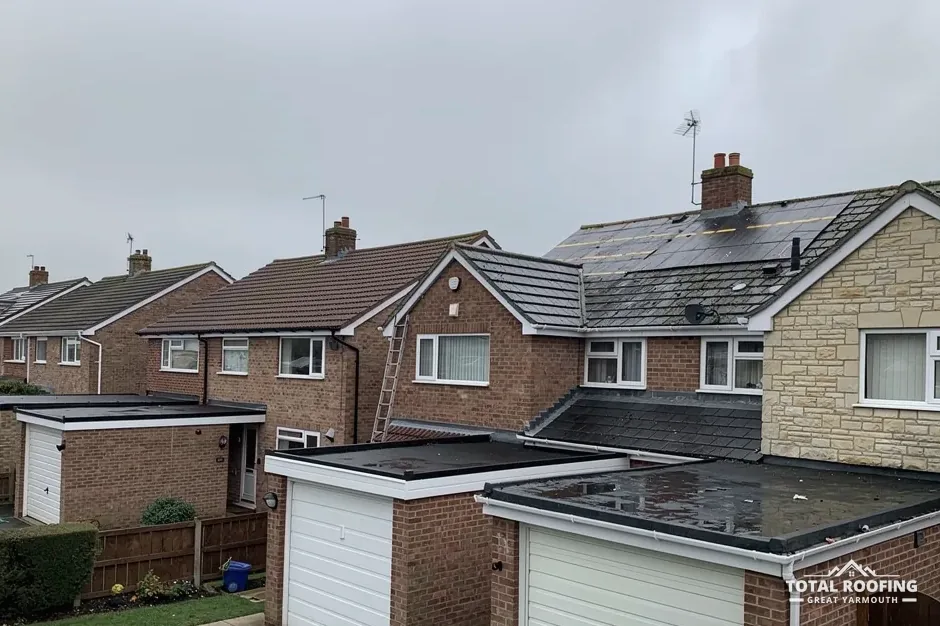
Brick semis with concrete tile roofs and flat-roofed garages

St Peter's, West Lodge and Bellevue

  • St Peter's church

    St Peter's carries a Grade I listing (National Heritage List entry 1305921, first listed 26 November 1959). The church belongs to the Church of England and the Diocese of Norwich, so a faculty authorises repairs to its roof.

    Whether the outside work also needs planning permission is a question for South Norfolk Council. The survey takes the nave, any porch and the gutters as three parts, each with its own finding, and the parish hears all three in plain terms.

  • West Lodge

    West Lodge is listed Grade II* (National Heritage List entry 1050771, first listed 14 April 1983). A lodge roof is small, but a small roof can still have valleys, a stack and lead, each of them part of the listing.

    Anything that would alter its character needs listed building consent from South Norfolk Council before work starts.

  • Bellevue and its neighbours

    Bellevue is listed Grade II (National Heritage List entry 1170875). Six listed buildings lie nearby in all, so these three entries make up half of the group, and a fourth house down the road may be listed too.

    Bawburgh has a conservation area nearby, and whether your own address lies inside one is for South Norfolk Council to say. Put that question to the council early, before you settle on a different tile or a new roof window.

Easton: lodge, church and council responsibilities

  • Planning: South Norfolk Council decides; the Broads executive area lies well away from Easton.
  • Building control: CNC Building Control, whose five-council partnership serves Easton from its Norwich office.
  • St Peter's, Grade I: Diocese of Norwich faculty replaces listed building consent; planning stays separate.
  • West Lodge, Grade II*, and Bellevue, Grade II: South Norfolk consent where the work changes character.
  • Scaffolding that overhangs a footway or lane needs Norfolk County Council's licence, which we arrange with our scaffolder.

Our planning guide covers when roof work needs consent, and your house is checked with the council before a date is agreed.

Map of Easton and the places nearest to it. Map tiles © Esri; map data © OpenStreetMap contributors.

Ask it straight · Easton

Easton roofs: St Peter's, listed lodges, flat roofs and roosting bats

Easton parish had 1,436 usual residents at the 2021 Census, in a place where a Grade I church, a Grade II* lodge and a Grade II house all sit close together. Next come four answers on who approves church and listed work, how long a flat roof lasts, and what the law says when a roof space is home to wildlife.

How do repairs to St Peter's church in Easton get approved?

The short answer

By a faculty from the Diocese of Norwich, which replaces listed building consent. Planning permission for exterior work is still a separate question for South Norfolk Council.

On the National Heritage List the Church of St Peter is entry 1305921, Grade I, first listed on 26 November 1959. Because it is a Church of England building in use, the ecclesiastical exemption applies, and a faculty takes the place of listed building consent. The Diocese of Norwich is the body that grants it. St Peter's is a parish church in use, in a benefice that also takes in Colton and Marlingford, so the faculty route is the one that applies here.

Only the one consent is replaced. Work to the exterior can need planning permission, which South Norfolk Council decides, and building control remains with CNC Building Control or a registered building control approver. A parochial church council can put all three questions at the start, since no one answer settles another, and the written price can follow once the answers are in.

The roof survey itself is the same sort of survey a house gets, scaled up. The covering, the lead at the abutments, the rainwater goods and the timbers visible from inside are each examined in turn, and the churchwardens hear what the survey turned up, with any extra points noticed on the way round added. Gutters on a church carry water from a large roof, so a blocked hopper is treated as seriously as a slipped slate, and a leaking joint in a lead gutter is followed to its cause.

Church roof survey, part by part

  • Nave covering and ridge
  • Porch roof and verges
  • Lead at abutments and gutters
  • Rainwater goods and outlets
  • Roof timbers seen from inside

What changes for a roof at West Lodge or Bellevue?

The short answer

Listing adds a consent step. Work affecting the character of West Lodge, Bellevue or any other listed house needs listed building consent from South Norfolk Council.

West Lodge is listed Grade II* (National Heritage List entry 1050771, first listed 14 April 1983), and Bellevue is Grade II (entry 1170875). Six listed buildings lie nearby altogether, so a house you pass on the road could carry a listing without any sign on the wall. Owners who are unsure can ask South Norfolk Council before they ask for a quote, and the council can say what the listing covers.

The legal test is a character test. Works need consent where they would be "in any manner which would affect its character as a building of special architectural or historic interest". Changing a covering, opening a roof for a window or rebuilding a chimney can each do that, and South Norfolk Council, as local planning authority, decides. We hold the written quote until the council has answered, because a price for work that is later refused would be wasted on both sides. If you are unsure whether a like-for-like repair counts as a change, the council can say how it treats that compared with a new covering.

A lodge or a small farmhouse raises its own roof questions. A short run of rafters can still carry a valley, a stack and a lean-to, and every joint between them is a spot where rain can get in. We follow each junction from inside the loft and from the roof itself, so a stain found below can be traced up to the joint that caused it, and the written price reflects what the whole roof needs.

Two listed houses side by side

West Lodge

  • Grade II*, entry 1050771
  • South Norfolk consent
  • Character test

Bellevue

  • Grade II, entry 1170875
  • South Norfolk consent
  • Character test

How many years can an Easton extension's flat roof give?

The short answer

It depends on the covering, and the sources disagree: HomeBuilding gives EPDM 25-30 years, while Less says 30 to 50. Neither is a forecast, and the falls are checked too.

Two published guides give lifespans for flat roof coverings. HomeBuilding lists EPDM at 25-30 years, GRP at 25-30 and felt at 10-15. Less says EPDM rubber "typically lasts 30 to 50 years", GRP fibreglass lasts 25 to 40 years with minimal maintenance, and torch-on felt lasts 10 to 20 years "depending on quality and installation". The ranges overlap but do not match, so neither is treated as the answer for a given roof.

A flat roof also has a drainage rule. BS 6229:2025 is the current code for continuously supported flexible membranes, replacing the 2018 edition withdrawn on 16 December 2025. NFRC says it sets "a minimum 1:80 finished fall for general roof areas and internal gutters", while IKO reports the code of practice says "the roof should be designed for a fall of 1:40" to achieve a 1:80 fall. Ponding on an old extension roof can point to a fall that was never enough.

A flat roof survey therefore covers the membrane, its upstands and laps, the outlets and the deck beneath. If the decking is soft, covering it again simply buries the fault, and a patch over a sagging panel holds water at the low point. Both problems are put in front of the owner in plain words before the written price is given. Our flat roofing page sets out the covering options.

Myth

Every flat roof covering lasts the same number of years.

Fact

HomeBuilding and Less give different ranges for EPDM, GRP and felt.

What does the law say about bats in an Easton roof?

The short answer

Bat roosts are protected whatever the intent; a bird's nest is shielded from intentional harm while "in use or being built". Bat roof work can need a Natural England licence.

Wildlife law reaches into roof spaces. Under the Wildlife and Countryside Act 1981 it is an offence if anyone intentionally "takes, damages or destroys the nest of any wild bird while that nest is in use or being built". The word intentionally matters there, and so does the phrase "in use or being built", which is a test of whether the nest is active.

Bats are treated more strictly. GOV.UK says "All bat species, their breeding sites and resting places are fully protected by law", and under the Habitats Regulations damaging or destroying a breeding site or resting place carries no intent word, so it is an offence whatever the intent. Disturbing a bat in its shelter or blocking its access is an offence where done "intentionally or recklessly". For bats, GOV.UK names "repairing or replacing a roof" as one of the works for which a Natural England licence may be required.

If droppings, staining at a gable or live bats turn up during a survey, work stops and the next step is a licensed ecologist, not the roofer. A WhatsApp photograph to 07880 284133 of what you have seen can come before any visit, and we look at it. Our roof repairs page covers the work that follows.

Easton: valleys, scaffold fees, storms and spray foam

A damp patch has appeared under the valley of my Easton roof: what is it?

A valley is the gutter where two slopes meet, lined with lead or another material, and it carries water from both slopes. A split lining, a lifted edge or debris in the channel can each let water through to the ceiling. From inside the loft, we trace the mark upward until it meets the valley. MyJobQuote says correctly installed lead flashing "can last for over 80 years".

What will scaffolding on an Easton lane cost in licence fees?

Norfolk County Council charges £178.33 for the first 28 days, and £178.33 again for each following 28 days. Its page asks applicants to "Please allow 7 calendar days for applications to be processed". We arrange the licence with our scaffolder. A frame that goes up again after a pause needs a new application, and our written quote carries the scaffold inside its single total.

My Easton roof lost slates in a gale: how does insurance see it?

The Financial Ombudsman Service says "a storm usually involves violent winds, usually with rain, hail or snow", and that it will "usually look at expert reports and photos" when a complaint reaches it. Take photographs before anything is moved, then tell the insurer. We can make the roof safe after that.

Is spray foam under an Easton roof a problem for a mortgage?

Energy Saving Trust says spray foam "doesn't automatically prevent you from getting a mortgage, but some lenders may ask for extra checks". The government's October 2026 paper adds that removal "will not always guarantee that they will still lend" and recommends advice from a specialist surveyor. Our spray foam removal page explains the work.

What does a new roof cost for an average Easton three-bedroom house?

Which? Trusted Traders priced "Replacing entire roof on an average three-bedroom house" at £7,000 to £21,000 excluding VAT, in a survey of 11 traders gathered in November 2025. Our price is one written total, set after a survey of your own roof, and it depends on access, size, the covering chosen and what lies under it. Which? says its figures include labour and materials.

Bawburgh, Costessey, Taverham and Barford

Price the Easton roof in writing

Tell us about your roof

10-year workmanship guarantee, in writing

Call WhatsApp Written quote