
Call 01493 277103

Barford, 29.1 road miles west

Roofers in Barford

Barford lies 29.1 road miles west of Great Yarmouth, 37 minutes by road. A call about a roof begins with a survey of every slope, and the consent route for your house is confirmed with the council before work is booked, so you know who decides what.

Get a written quote

Call 01493 277103WhatsApp us

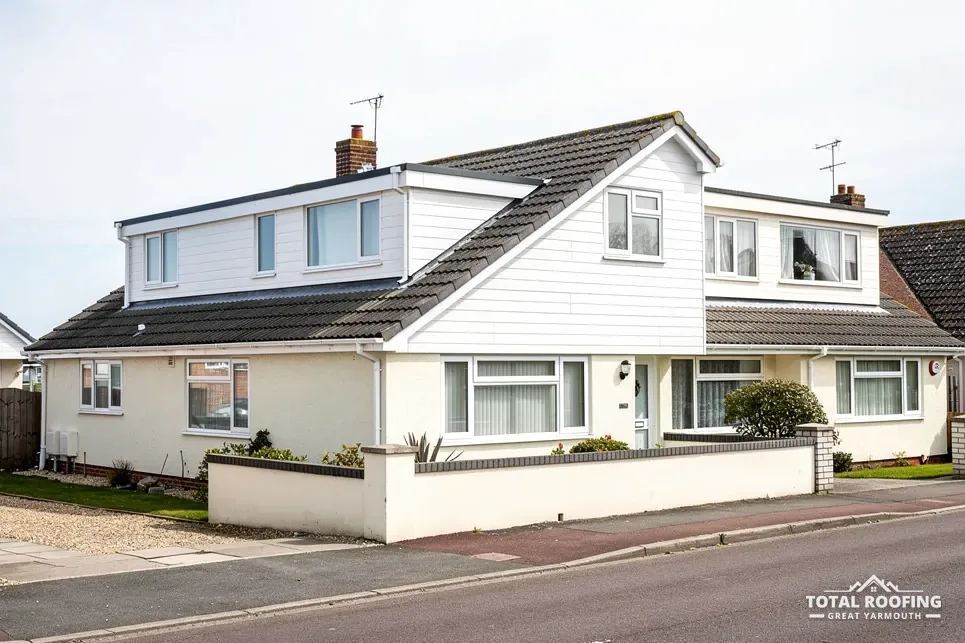
A pair of chalet bungalows with flat-roofed box dormers
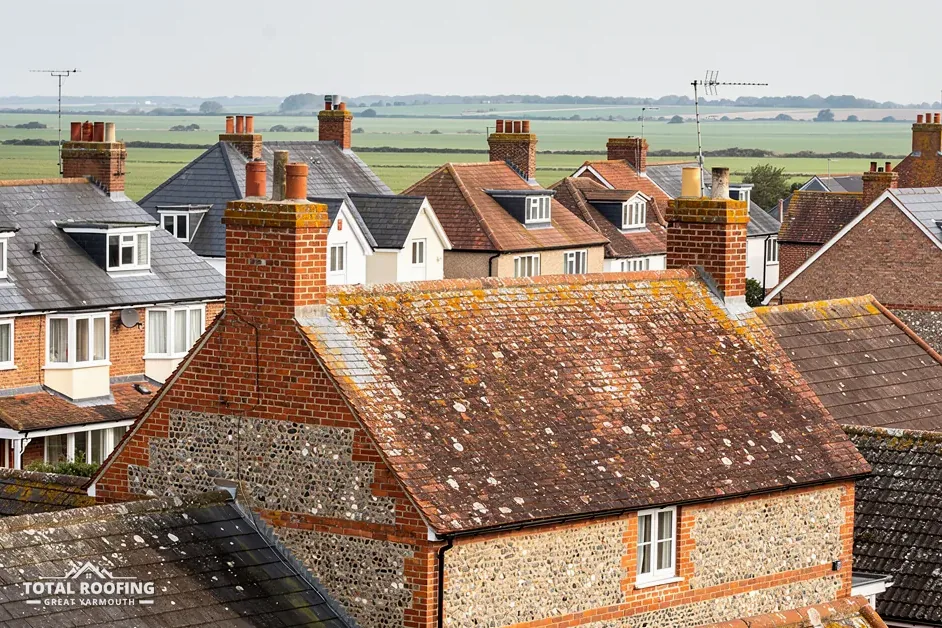
An old flint and brick cottage with a weathered clay tile roof

St Botolph's, School Farmhouse and Dalstrand

  • St Botolph's church

    The Church of St Botolph is listed Grade II* (National Heritage List entry 1050737, first listed 26 November 1959). As a Church of England church, its roof repairs go through the faculty system of the Diocese of Norwich, not through listed building consent.

    Outside work may still need planning permission from South Norfolk Council. The roof survey looks at the covering, the lead and the rainwater goods one after another.

  • School Farmhouse

    School Farmhouse is listed Grade II (National Heritage List entry 1050736, first listed 15 August 1983). A farmhouse roof can have several pitches and a lean-to or two, and every one gets its own look from the roof and from inside the loft.

    For any change that would alter its character, South Norfolk Council's listed building consent is needed before work starts.

  • Dalstrand and the Wramplingham area

    Dalstrand is listed Grade II (National Heritage List entry 1050735). Six listed buildings lie nearby altogether, and Wramplingham, a short way off, has a conservation area. A small roof with a single pitch is quicker to survey than a farmhouse, yet the same listing questions apply to any listed house.

    Whether your own house stands inside a conservation area is for South Norfolk Council to answer, so ask it before you settle on different tiles or a new roof window. A reply in writing is worth keeping with the house papers.

Barford: church, farmhouse and council duties

  • Planning: South Norfolk Council decides; the Broads executive area does not take in Barford.
  • Building control: CNC Building Control, the five-council partnership working from its Norwich office.
  • St Botolph's, Grade II*: faculty through the Diocese of Norwich; exterior planning stays separate.
  • School Farmhouse and Dalstrand, both Grade II: listed building consent where character would change.
  • Scaffold across a footway or lane: a Norfolk County Council licence, which we arrange with our scaffolder.

Our planning guide explains when a roof job needs permission, and the council confirms the route for your Barford address before work starts.

Map of Barford and the places nearest to it. Map tiles © Esri; map data © OpenStreetMap contributors.

Ask it straight · Barford

Barford roofs: church faculty, listed farmhouses, pitch rules and site safety

Barford parish had 514 usual residents at the 2021 Census, so this is a small parish where a Grade II* church and two Grade II houses make up a good part of the listed stock. The four answers below cover who approves what, what pitch a covering needs, and who is responsible for safety on a house roof job.

Who approves roof repairs at St Botolph's church in Barford?

The short answer

The Diocese of Norwich grants a faculty, which replaces listed building consent. A separate planning question for exterior work goes to South Norfolk Council.

St Botolph's is Grade II*, entry 1050737 on the National Heritage List, first listed on 26 November 1959. Church of England churches in use sit inside the ecclesiastical exemption, so a faculty from the Diocese of Norwich stands where listed building consent would otherwise be. The exemption does not stretch beyond that one consent.

Planning permission for exterior changes, where it is needed at all, is South Norfolk Council's to decide, and building control belongs to CNC Building Control or a registered approver. The three bodies answer different questions, so the parish can put all three at once. A faculty application is stronger when it rests on a proper survey of the covering, the lead and the gutters, because the diocese can then see what is wrong and what is proposed. In a small parish, with few people to organise a project, having the facts set out early saves time later.

On the roof, we look at the covering, the ridge, the flashings where roof meets tower or wall, and the gutters that carry water off a wide area. The churchwardens are told plainly what we found, together with anything else we saw. A photograph to WhatsApp (07880 284133) can come first, and we say what it shows and what only the roof itself can settle.

Church roof: the order of questions

  1. Survey covering, lead and gutters.
  2. Diocese of Norwich faculty.
  3. South Norfolk planning check.
  4. Building control through CNC or an approver.

Who looks after safety on a Barford house roof job?

The short answer

Under CDM 2015 a homeowner's client duties pass to the contractor, or to the principal contractor if several firms are involved. Every project has a construction phase plan.

The Construction (Design and Management) Regulations 2015 call a householder a domestic client, and HSE defines that as any individual who has construction work carried out on their home, not as part of any business. Regulation 7 hands those duties to the contractor when a project has one contractor, and to the principal contractor when it has several.

Each project also needs a construction phase plan. Regulation 15 says the contractor "must draw up a construction phase plan, or make arrangements for a construction phase plan to be drawn up", and regulation 12 puts the same duty on a principal contractor. For a roof that means thinking through access, edge protection, fragile materials and the safety of people below before the first tile is lifted.

A householder does not need to learn the regulations, but it helps to know that the duties exist. They sit with whoever runs the job. Where a roof contains asbestos cement sheeting, HSE's warning that "AC roofs are always fragile" shapes the whole plan, because nobody should be standing on it. A householder asking for a quote can reasonably ask who the contractor is and how the roof will be made safe to work on. Our roof replacement page describes a full re-roof from survey to finish.

Does School Farmhouse's listing change how its roof is repaired?

The short answer

Yes where the work would affect its character: South Norfolk Council grants listed building consent. A like-for-like patch is worth raising with the council first.

School Farmhouse is Grade II (entry 1050736, first listed 15 August 1983), as is Dalstrand (entry 1050735). The church is Grade II*. With six listed buildings nearby in all, a neighbouring house could be listed too, and the council can confirm the position for any address. A house can be listed without any plaque, and a listing covers the whole building, roof included, not only the front elevation people notice from the lane.

The consent test is written broadly: it covers works "in any manner which would affect its character as a building of special architectural or historic interest". Replacing a covering with another material, cutting in a roof window or taking down a stack can each cross that line. South Norfolk Council grants or refuses consent, so the written quote follows its answer. Repairing like with like is a lighter question than changing the covering, yet the council is still the one to ask, since a repair that alters the look of the roof is not like-for-like.

Conservation areas add a second layer, separate from listing. Wramplingham has one near Barford, and South Norfolk and Broadland's page counts 52 conservation areas within South Norfolk. Whether your house lies inside one is a question for the council, and an Article 4 direction can remove further permitted development rights, so check with the council first.

Ask South Norfolk before these

  • A different covering material
  • A new roof window on a street face
  • A rebuilt or removed chimney stack
  • Any work on a listed building's roof

What pitch do slates and pantiles need on a Barford roof?

The short answer

It depends on the product. Sandtoft's clay Old English Pantile has a 30° minimum pitch, and Cupa reports 20 degrees as BS 5534's minimum for natural slate.

Pitch is the slope of the roof, and each covering has a minimum. Sandtoft, part of Wienerberger, gives its clay Old English Pantile a minimum pitch of 30°, a headlap of 75 mm with a 290 mm fixed batten gauge, and it states a weight of 41.6 kg per m² as laid. Marley lists 15° for its Lincoln clay pantile and 25° for its concrete Anglia. Pantiles are made in clay and in concrete, and the product sheet decides.

For natural slate, Cupa reports BS 5534's minimum of 20 degrees at moderate exposure, with a 500 mm slate and a 115 mm overlap. Cupa adds that hook fixings are not used below 25°. BS 5534 is the code of practice for slating and tiling, and Marley notes that installing to it "isn't required by law"; the fixing specification is set for each site, which allows for how exposed the roof is.

Pitch is measured at the survey, and it narrows the choice before a covering is picked, so no one is quoted for a tile the slope cannot carry. A low-pitched lean-to behind a farmhouse may rule out a covering the main roof carries, so each pitch is judged on its own. Our pitched roofing page describes the coverings and how each is fixed.

Minimum pitches by product

Sandtoft clay Old English Pantile30° minimum
Marley Lincoln clay pantile15°
Marley concrete Anglia25°
Natural slate, Cupa on BS 553420 degrees, moderate exposure

Sources: Sandtoft, Marley and Cupa product information, read 11 November 2026. Always check the product sheet.

Barford: fascias, storms, scaffold and garage roofs

My Barford fascias are rotting: how long should uPVC last?

A retailer says uPVC fascia boards, "when installed correctly", "can typically maintain reliable performance for between 20 and 40 years". MyJobQuote gives an average of around £800 for capping fascias and soffits, on a page of 17 September 2026 with no VAT basis stated. Rot in the board behind the capping is checked at survey, with the soffit vents and the rafter feet beside it, because a capping can hide a soft timber. Our guttering, soffits and fascias page covers the repair.

A storm has stripped tiles from my Barford roof: what should I keep?

Keep photographs taken before anything is moved, and tell the insurer promptly. The Financial Ombudsman Service says "Rain, hail or snowfall by itself can constitute a storm" and that it will "usually look at expert reports and photos". We can look at a photograph sent to WhatsApp, and make the roof safe where that is needed. Slipped tiles that you can see from the ground are worth photographing from several angles, with a note of the date.

How much is scaffold licence paperwork for a Barford house?

Norfolk County Council charges £178.33 for the first 28 days and £178.33 again for each following 28 days, and asks applicants to allow 7 calendar days for processing. A new application goes in whenever a scaffold is erected again, so a job that pauses and restarts is licensed twice. We arrange the licence with our scaffolder, and our written quote is one total that covers the scaffold.

Where do old garage roof sheets from Barford go for disposal?

Norfolk County Council does not accept any asbestos at its recycling centres, so the sheets cannot go to the tip. HSE says "Use a lockable skip for asbestos", and it treats cement sheeting removed whole without breaking up as non-licensed work. If a sheet is broken the job changes class, so the material is identified before it is touched. Garage roofs built or refurbished before 2000 are treated as suspect in HSE's advice, and that holds for outbuildings in Barford as much as anywhere.

How long might a Barford conservatory roof last?

HomeBuilding says polycarbonate roofs have "a typical lifespan of 10 years". Roofing Megastore's managing director, quoted by HomeBuilding, says a glass roof "will likely last in excess of 30 years" and a tiled one "will typically last in excess of 50 years with little maintenance". A solid replacement roof is a building regulations matter, so the route is checked first.

Easton, Bawburgh, Hethersett and Little Melton

Barford roof, one written price

Tell us about your roof

10-year workmanship guarantee, in writing

Call WhatsApp Written quote