
Call 01493 277103

Pulham St Mary: 29.7 road miles

Roofers in Pulham St Mary

Roofers for repairs, re-roofs and leadwork around Pulham St Mary, 29.7 road miles from Great Yarmouth. A survey of the full roof opens every job, with a plain account of what it showed, and the council route is checked before work begins.

Get a written quote

Call 01493 277103WhatsApp us

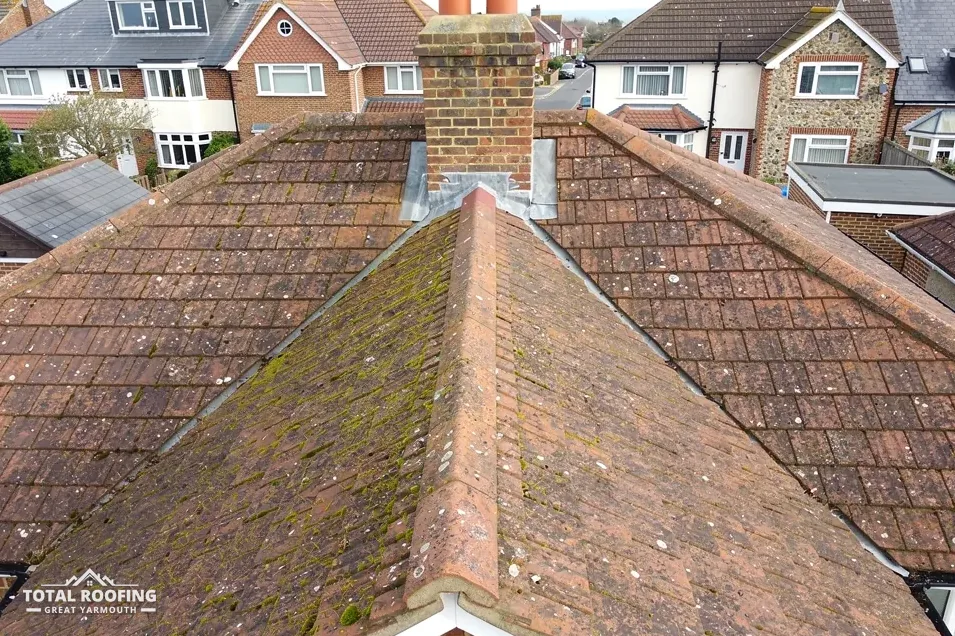
A high view looking down on a clay tile roof, its ridge, hips and brick chimney
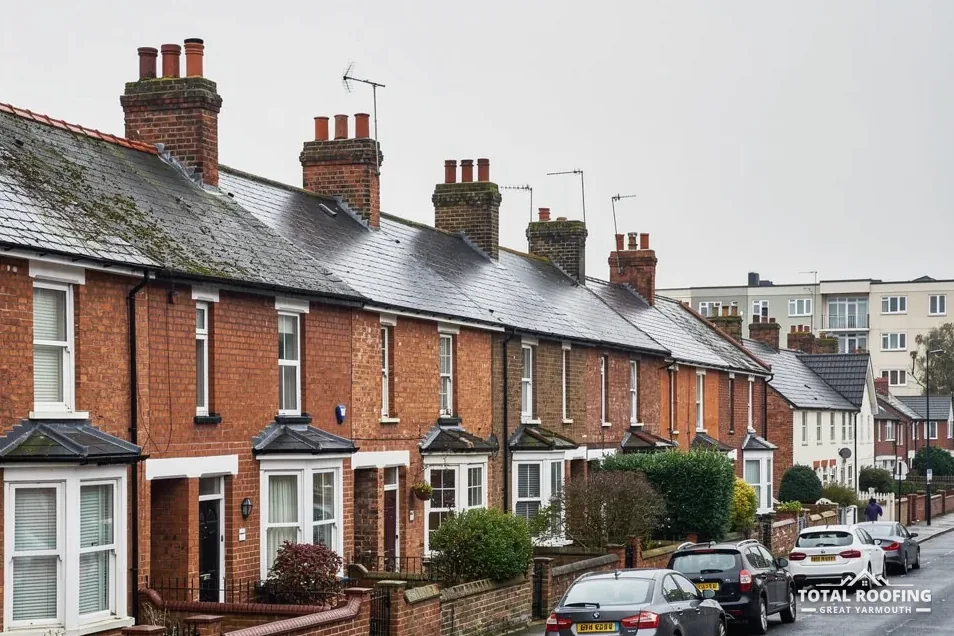
A row of Victorian brick terraces with slate roofs and chimney stacks

From St Mary's to Glebe Farmhouse

  • Pulham St Mary's conservation area

    South Norfolk Council designated the Pulham St Mary Conservation Area. Ask the council whether your street sits inside it before you change the covering or fit a roof window. The council's page says: "There are 21 conservation areas within Broadland, and 52 within South Norfolk." An Article 4 direction can remove further permitted development rights, so check with the council first.

    The call may concern a single slipped tile, yet the survey reads the whole roof: bedding along the ridge, edges at the verges, valley linings and the flashings round every stack and wall junction.

  • King's Head and Glebe Farmhouse

    Two Grade II entries stand on the National Heritage List here: The King's Head Public House (entry 1303264, first listed 26 June 1981) and Glebe Farmhouse (entry 1373325). In all, 34 listed buildings lie within about a kilometre.

    A listed home keeps its permitted development rights for roof work. Consent still applies to any work that touches the building's character, so the council hears about a listed roof before any change is agreed, and the survey examines covering, leadwork and timbers alike.

  • St Mary's church roof

    Entry 1050185 on the National Heritage List is the Church of St Mary, Grade I, first listed 7 December 1959. Work to its roof follows the Church of England faculty system, explained in the final chapter below.

    Standing beside a listed church does not make a house listed. Only a house's own list entry settles that, and the National Heritage List can be searched by address before you assume either way.

Pulham St Mary approvals, council by council

  • Planning: South Norfolk Council decides it for every Pulham St Mary address.
  • Building control: CNC Building Control from its Norwich office, or a registered building control approver.
  • Pulham St Mary has a conservation area, designated by South Norfolk Council.
  • Church of St Mary, Grade I: faculty system, and planning permission may still be needed outside.
  • The King's Head and Glebe Farmhouse, both Grade II, need consent for changes affecting their character.

When does roof work need permission? The planning guide answers it, and the council confirms which route suits your address ahead of any work.

Map of Pulham St Mary and the places nearest to it. Map tiles © Esri; map data © OpenStreetMap contributors.

Ask it straight · Pulham St Mary

Four Pulham St Mary answers, from building control to the church faculty

Pulham St Mary parish had 906 usual residents at the 2021 Census. Its roofs fall under South Norfolk Council for planning and a council partnership for building control. These four answers say which body rules on each part of a job, from re-roof thresholds to the church. Rules that belong to Norfolk County Council are named as such.

Which Pulham St Mary roof jobs go to CNC Building Control?

The short answer

A whole re-roof does, since it reaches over 50 per cent of the roof. Smaller repairs normally need no application while both Planning Portal limits hold.

Start with the Planning Portal's test. An application is normally unnecessary when "Less than 25 per cent of the total 'building envelope'" is touched and "Less than 50 per cent of the roof is affected", and the two limits apply together. Stripping and recovering an entire roof exceeds the second limit with any covering, so building control hears about it before any stripping starts. A repair confined to one slope is measured against both limits first.

Weight is a separate trigger. Where a new covering is "15 per cent or more" heavier than what is on the roof, approval is needed, and the Planning Portal says to get a structural engineer or surveyor to look first. Approval is also needed if the new covering would behave quite differently in a fire. Because of both tests, the survey includes the rafters and wall plates below the covering as well as the surface seen from the lane.

Building control in Pulham St Mary comes from CNC Building Control, reached through its Norwich office on 0808 168 5041 for this part of Norfolk. CNC Building Control serves as a partnership of five councils whose members are South Norfolk, Norwich City, Broadland, King's Lynn & West Norfolk and Fenland. You may instead use a registered building control approver. CNC's guide to roof types says a warm roof has "No ventilation is required for these types of roofs." while a cold roof has "Ventilation is required for these roofs." Larger jobs are on our roof replacement page.

Parts checked before a re-roof is priced

  • Ridge bedding and fixings, plus any open joints
  • Verge mortar or dry-fix parts, and valley linings
  • Flashings at every wall and stack junction
  • Underlay and battens, as seen from inside the loft
  • Rafters and wall plates beneath the covering
  • Gutters and downpipes at the eaves

What does a scaffold licence cost on a Pulham St Mary road?

The short answer

Norfolk County Council charges £178.33 for the first 28 days, then £178.33 again for each further 28 days. We arrange the licence with our scaffolder.

Putting scaffolding over a pavement or road requires a licence under section 169 of the Highways Act 1980, which reaches any scaffolding a person may "erect or retain on or over a highway". Even a frame set back from the kerb is covered if any part of it projects over the footway. The licence for Pulham St Mary comes from Norfolk County Council as county highway authority, not from South Norfolk Council.

Norfolk County Council's charge is £178.33 for the first 28 days, repeated at £178.33 for each later 28-day period. The fee is flat for each period, with no per-metre element. Norfolk County Council's £178.33 covers one 28-day period, so a long job pays it again for each further 28 days. Applicants are told: "Please allow 7 calendar days for applications to be processed." Each time a scaffold goes up needs its own application, so scaffolding put up again for a second stage is licensed afresh.

Any scaffold this job needs is priced inside the one written total. On the licence itself, we arrange the licence with our scaffolder. A licence period that ends mid-job does not bring the frame down: further 28-day periods are paid at the same figure. How the frame is set out depends on the frontage, so the survey looks at the house from the road before the roof is climbed.

Myth

One licence fee covers a scaffold for the entire job.

Fact

Norfolk County Council charges £178.33 for each further 28 days.

Where does asbestos cement from a Pulham St Mary shed go?

The short answer

Not to any Norfolk recycling centre, because the county council turns away every type of asbestos at its sites. HSE says asbestos waste goes in a lockable skip.

Assume it is present first. HSE puts it plainly: "If the building was built or refurbished before 2000, assume that there is asbestos in it." Corrugated cement sheeting, cement gutters and cement downpipes on a garage or outbuilding are candidates, and HSE lists "AIB white soffit panels to underside of roof eaves" as a place asbestos insulating board (AIB) turns up.

What HSE calls non-licensed work covers asbestos cement roof sheeting removed with care and kept whole, and weathered sheets count too, provided there is no other substantial damage. Damage that is substantial, or sheets that fire or flood has broken up, makes it notifiable non-licensed work (NNLW). On AIB, most work is licensed. HSE's A14 guidance adds "AC roofs are always fragile", so nobody walks on them.

Norfolk County Council states: "We do not accept any type of asbestos at any of our recycling centres, even during our hazardous waste events." It advises hiring a licensed specialist contractor to remove and dispose of every type. HSE's rule for the waste: "Use a lockable skip for asbestos", because "it is not good enough to throw sheeting over a standard skip". Domestic hazardous waste moves under a consignment-note exemption that is "other than asbestos waste", so asbestos never travels with ordinary rubbish.

Asbestos shorthand on a roof survey

  • ACAsbestos cement, as in roof sheets
  • AIBInsulating board containing asbestos, seen in soffits
  • NNLWNotifiable non-licensed work on damaged cement sheets
  • Lockable skipWhere HSE says asbestos waste is held

Who approves repairs to the roof of St Mary's church?

The short answer

The Church of England faculty system, not listed building consent, since the church is in use. South Norfolk Council still handles any planning permission for exterior work.

St Mary's is a Grade I listed church (National Heritage List entry 1050185, first listed 7 December 1959). As a Church of England building still used for worship, it falls under the ecclesiastical exemption, which takes the place of listed building consent. The church is in the Diocese of Norwich, and its roof work goes through the faculty system rather than a consent application to the council.

That exemption stands in for listed building consent and nothing wider. Planning permission for exterior work stays with South Norfolk Council, and building control stays with CNC Building Control or a registered building control approver. For a church roof the survey is the one a house receives, covering the leadwork, gutters, timbers and covering, reported in plain language to whoever looks after the building.

Neither the King's Head Public House (entry 1303264, first listed 26 June 1981) nor Glebe Farmhouse (entry 1373325) is a church, and both are Grade II, so each follows the ordinary listed-building route: consent is needed for works "in any manner which would affect its character as a building of special architectural or historic interest", and it comes from South Norfolk Council as the local planning authority. Ask the council before any listed roof is altered.

A Grade I church, a Grade II pub

St Mary's church

  • Faculty system
  • Diocese of Norwich
  • Planning permission may also apply

The King's Head

  • Listed building consent
  • Grade II, entry 1303264
  • Covers changes to its character

Pulham St Mary: gales, floods, prices, contracts

Ridge pieces loose after a gale at Pulham St Mary: what first?

Photograph the damage from the ground while everything is still where it fell, then contact your insurer. In a complaint, the Financial Ombudsman Service says "we'll usually look at expert reports and photos", and that "a storm usually involves violent winds, usually with rain, hail or snow". A photo sent to WhatsApp (07880 284133) gets looked at. Making a damaged roof safe is covered on our emergency roof repairs page.

Who approves a new solid roof on a Pulham St Mary conservatory?

Under the Planning Portal's guidance, "A new roof must comply with building regulations", so CNC Building Control is asked about the route first. Planning permission may also be required when the structure or appearance of the roof is changed significantly; South Norfolk Council, which designated a Pulham St Mary conservation area, takes that question. Our conservatory roofs page lays out the options.

Why do two Pulham St Mary roofs get different prices?

Size, covering, reach and anything the survey uncovers underneath all move the figure. Scaffold, where needed, forms part of the written quote. For scale, Which? Trusted Traders gave £7,000 to £21,000 excluding VAT when the whole roof of an average three-bedroom house is replaced (survey of 11 traders, November 2025). We give one total price after the survey, whether the job is a ridge repair or a full re-roof.

What cancellation rights apply to a roof contract in Pulham St Mary?

A contract made at your home can be cancelled, because "the cancellation period ends at the end of 14 days after the day on which the contract is entered into". Work that begins sooner needs a written request from you, which leaves the right intact, although payment for work already done may be due. For a visit you request for urgent repairs, no right exists where "the consumer has specifically requested a visit from the trader for the purpose of carrying out urgent repairs or maintenance".

Where can I check flood risk for a Pulham St Mary address?

GOV.UK's long-term flood risk checker covers an area's long-term risk from surface water, rivers, groundwater and reservoirs, yet "it does not tell you how likely it is that an individual property will flood". Floodline's number is 0345 988 1188. Planning applications use the Environment Agency's flood map for planning, which shows a site's flood zone; the zone belongs to the site, never to the whole village.

Start your Pulham St Mary quote

Tell us about your roof

10-year workmanship guarantee, in writing

Call WhatsApp Written quote