
Call 01493 277103

Gisleham, 15.1 road miles south

Roofers in Gisleham

Gisleham is 15.1 road miles south of Great Yarmouth. Roofs there, from a Grade I church to a listed barn, get a survey of every slope, flashing and gutter, an answer in plain words, and the council route checked before work is booked.

Get a written quote

Call 01493 277103WhatsApp us

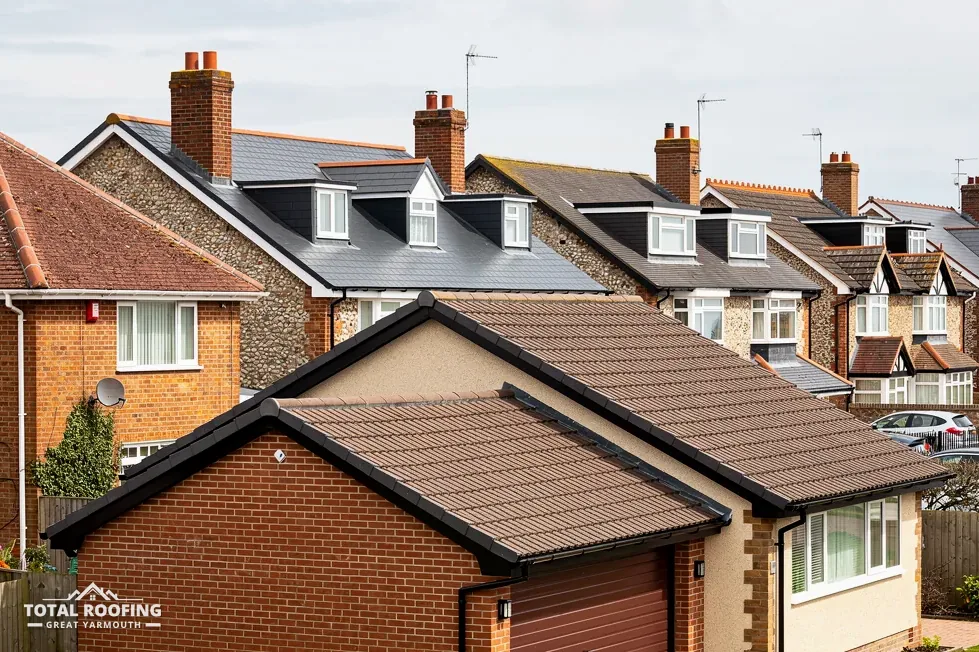
A detached brick garage with a newly re-tiled pitched roof
Tiled roofs across a row of houses seen from above

Holy Trinity, Trinity Barn, the Old Rectory

  • Holy Trinity church, Grade I

    Gisleham's church of Holy Trinity holds a Grade I listing (National Heritage List entry 1182784, first listed 17 April 1986). Its roof comes under the Church of England faculty system and the Diocese of Norwich, because a church still in worship use sits outside listed building consent.

    Planning permission for an exterior change still has to come from East Suffolk Council. The survey treats a church roof like any other, from ridge to gutters, and reports in plain words.

  • Trinity Barn, Grade II

    Trinity Barn is listed Grade II (National Heritage List entry 1032073, first listed 17 April 1986). Re-covering a listed barn roof is a change East Suffolk Council weighs against the building's character.

    Battens, rafters and any lead are checked from inside the building as well as from outside, because the roof structure of an older building is the part a covering hides.

  • Gisleham's Old Rectory, Grade II

    Another Grade II house here is The Old Rectory (National Heritage List entry 1032075). With 4 listed buildings nearby, the three named on this page are examples, not the full set.

    A chimney on a house of this kind is looked at as closely as the slopes: the pointing, the flaunching, the lead trays and the flashings where the stack leaves the roof.

Gisleham: who signs off roof work

  • Planning: East Suffolk Council decides, including for exterior work on the church.
  • Building control: East Suffolk Council's team or a registered building control approver.
  • The South Lowestoft and Kirkley Conservation Area lies nearby; ask the council about your address.
  • Holy Trinity, Grade I: faculty route via the Diocese of Norwich.
  • Trinity Barn and The Old Rectory, Grade II: consent for works affecting character.

The planning guide has the full rules for roof work. A Gisleham route is checked with the council before any job starts.

Map of Gisleham and the places nearest to it. Map tiles © Esri; map data © OpenStreetMap contributors.

Ask it straight · Gisleham

Gisleham roofs: Holy Trinity, the barn, bats and birds, and lead

Gisleham parish had 779 usual residents at the 2021 Census, and its listed buildings carry the questions that matter for roof work. The four answers below take the Grade I church, a listed barn, the law on bats and nesting birds, and lead flashing in turn.

Which route covers the Grade I roof of Holy Trinity, Gisleham?

The short answer

The Church of England faculty system, with the Diocese of Norwich, in place of listed building consent. East Suffolk Council still decides planning for outside work.

Gisleham's church of Holy Trinity holds a Grade I listing (National Heritage List entry 1182784, first listed 17 April 1986). Grade I is the highest grade, and a church in use for worship within the Church of England falls under the ecclesiastical exemption. That puts roof repairs through the faculty system run with the Diocese of Norwich, so a parish does not apply to the council for listed building consent. Whether a fresh covering may differ from the old one at all is a question for the diocese's process, and the survey supplies the facts it needs.

The exemption stands in for listed building consent and nothing else. East Suffolk Council remains the body for planning permission on exterior work, and building control goes to the council's own team or to a registered building control approver. Anyone from the parish asking about a slipped slate or a failed gutter gets the same plain survey a householder would: what was found, which part of the roof it sits on and what each repair involves. Where a roof spans an older timber frame, the survey also looks at how the wall plate carries the load of the rafters and whether any joint has opened.

4 listed buildings lie nearby, and Holy Trinity, Trinity Barn and The Old Rectory are the three named on this page. Any other building is checked on the National Heritage List by address, because a survey of the roof cannot say whether a house is listed, and the council is the place to confirm what a listing covers.

Parts of a church roof surveyed

  • Covering, slope by slope
  • Lead at parapets, valleys and abutments
  • Gutters, downpipes and outlets
  • Timbers of the roof frame, viewed from within
  • Ridge and verge fixings

Does a listed barn like Trinity Barn need consent for new tiles?

The short answer

Where the change would affect its character, yes. Trinity Barn is Grade II, so East Suffolk Council is asked before the covering changes.

Trinity Barn is listed Grade II (National Heritage List entry 1032073, first listed 17 April 1986). A listed building needs consent for works "in any manner which would affect its character as a building of special architectural or historic interest". Colour, material and fixings can each change a barn's character, and the roof is a very visible part of any barn, so a new covering is a clear example.

Repair in matching materials is a different question from replacement, and only the council can say where the line sits for a given building. Raising it before pricing means the covering, the fixings and the lead details are chosen once, not revised after a refusal. The Old Rectory is listed Grade II (entry 1032075) and follows the same consent route as the barn.

Planning permission and listed building consent are two applications with two tests, and a job can need either one alone or both together. Pitched roofs of this age also reward a long look from the loft: the rafters, the purlins and the wall plates show whether the structure under the covering is sound, and that decides whether a repair or a re-roof is the right call. Gutters and fascias on a listed building are looked at under the same consent question, since a change of profile or material alters how the eaves read.

Myth

A church roof needs the same listed building consent as a house.

Fact

Churches of the Church of England in use follow the faculty system.

Do bats or nesting birds stop a Gisleham re-roof?

The short answer

They can change the plan: roost damage is an offence however it happens, and a nest in use or being built is protected.

Section 1 of the Wildlife and Countryside Act 1981 protects birds' homes: the offence catches anyone who intentionally "takes, damages or destroys the nest of any wild bird while that nest is in use or being built". The law turns on the state of the nest, not on the calendar: a nest in use or being built is covered, wherever in the roof it sits.

For bats the test is tougher. Damage to a roost is an offence however it came about, while blocking a roost's entrance is an offence if done "intentionally or recklessly". A Natural England bat licence can be needed for "repairing or replacing a roof", among other works, which is why the survey looks in the loft and under the eaves for any sign of use before a covering comes off.

An old barn, a church and a rectory all give a bat or a bird somewhere to settle, so Gisleham's older roofs are worth that extra look. The loft look is done in daylight with a torch, for droppings, staining at the ridge and gaps where roof meets wall. A bird's nest lodged in guttering, or tucked under a verge, gets the same attention as one in a roof void. Finding either animal is a reason to stop and take advice from a licensed ecologist or Natural England, not to carry on, and the programme is then planned around what that advice says.

The law in brief

  1. Wild bird nest: protected while in use or being built.
  2. Bat roost: damaging it is an offence, intent aside.
  3. Blocking a roost: an offence if intentional or reckless.
  4. A re-roof can need a Natural England bat licence.

What lifespan can lead flashing reach on an old Gisleham roof?

The short answer

Correctly installed lead flashing has a long life, and the specification sets which lead code each detail gets.

Lead is the metal along chimney stacks, wall abutments, valleys and around roof windows, and it is where an older roof meets a wall. MyJobQuote says correctly installed lead flashing "can last for over 80 years". That depends on the installation: the chase, the fixings and the overlaps all have to be right for the figure to apply, and an old roof's lead does not show its age from the ground.

Leadworx, a lead flashing maker, lists codes 3 to 8, set by the LSTA, as complying with BS EN 12588, and says "Code 4 has become the standard choice for general flashing work". The specification sets the code for each detail, so the flashing on a stack and the lining of a long valley need not use the same one, and the survey notes which details are lead before the written price is set. Chimney lead is its own job: a stack has an apron at the front, step flashings along each side and a back gutter behind, and each piece laps the next.

Old lead that has cracked at the folds or slipped from its chase is renewed rather than covered over. A bead of sealant on top hides a failing flashing without curing it. When flashing is renewed, the pointing it is chased into is checked at the same time, since a new strip of lead set into crumbling mortar gives little. Our lead roofing and leadwork page describes the details one by one.

Lead terms for Gisleham roofs

  • Code 4Leadworx calls it the standard flashing choice.
  • LSTASets lead codes 3 to 8, per Leadworx.
  • BS EN 12588The standard Leadworx says codes 3 to 8 meet.
  • FlashingLead sealing a roof against a wall or stack.

Gisleham roofs: ridge tiles, asbestos, foam, gutters, scaffold

A ridge tile has dropped into my Gisleham garden: is the rest safe?

A fallen tile can point to bedding or a fixing that has let go at that spot, and it does not show how the rest of the ridge stands. Keep people away from below it, photograph the tile and the gap from the ground, and send the pictures to 07880 284133. A survey then checks the whole ridge and the hips. See roof repairs for what that covers.

Can asbestos cement sheets from a Gisleham outbuilding go to a recycling centre?

Suffolk's rule is that "you cannot take it to any Suffolk Recycling Centre"; Suffolk County Council's contractor collects small amounts of household cement-bonded asbestos for a fee instead. HSE advises: "If the building was built or refurbished before 2000, assume that there is asbestos in it". Its guidance on roofing sheets reads "AC roofs are always fragile". Cut or broken sheets are a different class of work from whole ones.

Will spray foam under my Gisleham roof affect a mortgage?

DESNZ says "Many mortgage providers are open to lending on properties with spray foam, subject to their own requirements." Removal "will not always guarantee that they will still lend", so DESNZ advises taking advice from a specialist surveyor. RICS has reported "concern within specific sectors of the lending market, such as equity release mortgages". See spray foam insulation removal for the options.

What fall should the gutters on my Gisleham house have?

Brett Martin gives a fall of "1mm for every 600mm" towards the outlet. A run that sags between brackets holds standing water, spills over the front edge and soaks the fascia behind it, so the survey checks the line of each run, the brackets and the joints as well as the downpipe outlets.

Can I apply for scaffold at my Gisleham house myself?

Not as an individual. Suffolk County Council's scaffold licences are "only issued to scaffolding companies with qualified scaffolders" and "not issued to individuals", at £260 for the first four weeks and £130 per four-week extension in 2026-27. Its page adds: "Applications require 10 working days notice to be processed." Our house line is that we arrange the licence with our scaffolder.

Carlton Colville, Kessingland and Lowestoft nearby

Gisleham roof quote, one total

Tell us about your roof

10-year workmanship guarantee, in writing

Call WhatsApp Written quote